
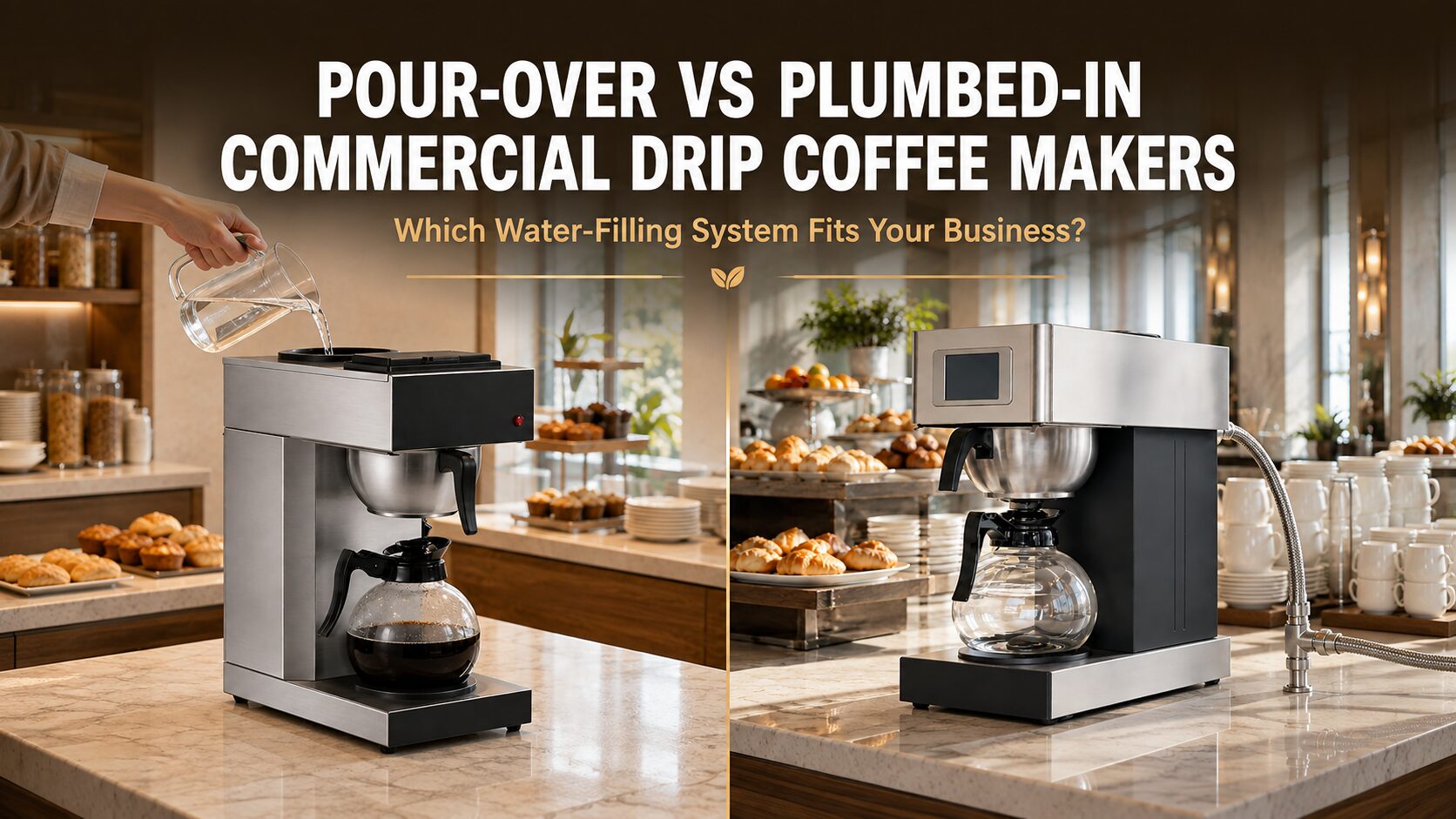
Pour-Over vs Plumbed-In Commercial Drip Coffee Makers: Which Water-Filling System Is Right for You?
When choosing a commercial drip coffee maker, buyers often focus first on batch size, brewing speed, and the number of warmers. One practical decision is just as important: how will water enter the machine?
A pour-over commercial drip coffee maker is filled manually by the operator. A plumbed-in commercial drip coffee maker connects to a water supply and fills automatically. Some commercial models support both methods, allowing the operator to choose manual or automatic filling according to the installation.
Neither system is automatically better. Pour-over machines offer flexible placement and simple installation. Plumbed-in machines reduce repetitive filling and support a smoother workflow when coffee is brewed frequently.
This guide compares both options by installation, staff workload, service volume, water quality, operating flexibility, and business type so you can choose the right setup for your operation.
1. Quick Answer: Pour-Over or Plumbed-In?
Choose a pour-over drip coffee maker when you need easy installation, flexible placement, moderate brewing frequency, or the ability to move the coffee station.
Choose a plumbed-in drip coffee maker when the machine will stay in a fixed position, staff brew many batches each day, and reducing manual refilling will improve peak-hour service.
Consider a dual-fill model when you want automatic filling during normal operation but also need a manual-fill option for temporary setups, locations without a permanent water connection, or backup use.
The best decision depends less on total daily cup volume than on how often the machine must be refilled during the busiest service period.
2. What Is a Pour-Over Commercial Drip Coffee Maker?
A pour-over commercial drip coffee maker has an internal water tank or reservoir that the operator fills manually. Water is normally poured into an opening at the top of the machine before each brewing cycle or after several cycles, depending on the tank design.
The basic workflow is straightforward:
- Place filter paper and ground coffee in the brew funnel.
- Fill the machine with the required amount of water.
- Position the decanter or Airpot below the funnel.
- Start the brewing cycle.
- Refill the reservoir when the machine requires more water.
Because no permanent inlet pipe is required, pour-over brewers can be installed wherever a suitable electrical supply and safe working surface are available.
They are commonly used in:
- small and medium offices
- meeting and training rooms
- bakeries and convenience counters
- small cafés and restaurants
- temporary breakfast stations
- catering and mobile service setups
- locations where plumbing work is difficult
The main advantage is flexibility. The trade-off is that an operator must monitor and refill the water supply.
3. What Is a Plumbed-In Commercial Drip Coffee Maker?
A plumbed-in commercial drip coffee maker connects directly to a potable water supply. When a brewing cycle begins, the machine draws the required water automatically instead of relying on an operator to pour it into the reservoir.
A typical installation may include:
- a nearby cold-water connection
- a shut-off valve that staff can access
- a suitable inlet hose or fitting
- a pressure regulator when required by the machine or site conditions
- a water filter or treatment system
- enough clearance for inspection and maintenance
Once correctly installed, automatic filling removes a repetitive step from every brewing cycle. This can be valuable in busy operations where staff prepare batch after batch during breakfast, meetings, events, or other peak periods.
Plumbed-in brewers are commonly used in:
- hotel breakfast buffets
- busy restaurants and diners
- large offices and staff canteens
- conference and event facilities
- institutional foodservice
- high-traffic self-service coffee stations
- fixed café batch-brew stations
The main advantage is workflow efficiency. The trade-off is that installation, water quality, and machine position need more planning.
4. Pour-Over vs Plumbed-In: Quick Comparison
| Comparison Point | Pour-Over / Manual Fill | Plumbed-In / Automatic Fill |
|---|---|---|
| Water supply | Operator pours water into the machine | Machine draws water from a connected supply |
| Installation | Usually requires only suitable power and counter space | Requires a compatible water connection and installation planning |
| Placement | Flexible and easier to relocate | Best for a permanent coffee station |
| Operator workload | Water must be measured or refilled manually | Reduces repetitive water filling |
| Peak-hour workflow | Suitable when brewing frequency is manageable | Useful when many batches are prepared in succession |
| Water treatment | Treated or bottled water can be poured in directly | An inline filtration or treatment system may be needed |
| Initial setup | Simple and normally lower in complexity | May involve plumbing parts, labor, and site checks |
| Best fit | Flexible, low-to-moderate frequency service | Fixed, repeated, high-frequency service |
This table describes the general operating difference. Exact installation requirements, inlet pressure, voltage, brewing capacity, and filling controls vary by model and market, so the supplier specification should always be checked before purchase.
5. Compare Staff Workload During the Busiest Hour
Manual filling may seem like a small task, but repeated steps become more important during a rush.
For one or two batches, pouring water into a brewer is normally easy. If an employee must brew continuously, the same task competes with grinding or dosing coffee, replacing filter paper, moving decanters, cleaning the service area, and helping customers.
To judge the real impact, observe one peak service period and record:
- how many batches are brewed
- how often the reservoir must be refilled
- how far staff carry water
- whether refilling delays the next cycle
- whether empty decanters create waiting
- whether one operator manages several beverage tasks
If manual filling does not interrupt the workflow, a pour-over machine may be fully adequate. If staff repeatedly stop other work to carry and measure water, automatic filling can remove a real operational bottleneck.
For a broader output calculation, use our Commercial Drip Coffee Machine Capacity Guide. It explains how to compare batch size, brewing time, holding capacity, and peak-hour cup demand.
6. Check the Site Before Choosing a Plumbed-In Brewer
A water connection should be planned before the machine arrives. A suitable pipe somewhere in the building is not enough; the connection must be practical for the actual coffee-station position.
Confirm the following with the equipment supplier and a qualified local installer:
- Water source: Is a potable cold-water line available near the brewer?
- Inlet pressure: Does the site pressure fall within the machine's specified range?
- Connection size: Are the valve, hose, and fittings compatible?
- Shut-off access: Can staff isolate the water supply without moving heavy equipment?
- Filtration: Does local water require sediment, chlorine, hardness, or scale treatment?
- Drainage and leak protection: What precautions are appropriate for the counter and floor?
- Service clearance: Can technicians reach the inlet and internal components?
- Electrical supply: Does the site provide the correct voltage, frequency, plug, and circuit capacity?
Electrical and plumbing requirements should be checked together. A convenient water line does not help if the coffee station cannot safely supply the machine's rated power.
7. Water Quality Matters for Both Systems
Water affects coffee flavor and the long-term condition of the brewer. Minerals, sediment, chlorine, and other characteristics vary between locations.
A pour-over machine gives the operator flexibility to use filtered or bottled water, but it also depends on staff consistently using the correct water. If different employees refill the machine from different sources, cup quality and scale formation may become less predictable.
A plumbed-in brewer can provide a more consistent supply when it is connected to a correctly selected filtration or treatment system. However, the filter must be sized for the expected volume, installed correctly, and replaced according to the cartridge condition and supplier guidance.
Do not assume that every filter solves every water problem. Water hardness, sediment, taste, odor, and corrosion risk may require different treatment approaches. When local water is very hard or unusual, obtain a water analysis and ask the equipment or filtration supplier for a suitable recommendation.
Regular descaling and maintenance are still necessary when required by the machine and local water conditions. Automatic filling makes operation more convenient; it does not eliminate mineral buildup.
8. Consider Placement, Mobility, and Future Changes
Pour-over machines are useful when the coffee station may change location. An office can move the brewer between meeting areas, a hotel can create a temporary event station, and a caterer can use the machine at different venues as long as suitable power is available.
A plumbed-in brewer is better treated as part of a permanent service layout. Moving it may require shutting off water, disconnecting fittings, checking the new site, and arranging another installation.
Before choosing, ask:
- Will the machine remain on the same counter for several years?
- Could the business renovate or reorganize the beverage station?
- Will the brewer be used for off-site events?
- Is the current location rented or temporary?
- Could a future increase in demand justify a larger or dual-station brewer?
If the layout is uncertain, manual filling or a machine that supports both filling modes can protect flexibility.
9. Which Filling System Fits Different Businesses?
Small Office or Meeting Room
A pour-over brewer is often the simplest choice when staff prepare a few batches at predictable times and there is no water line at the coffee station. It can be positioned near the meeting area and moved if the office layout changes.
Large Office or Staff Canteen
A plumbed-in brewer becomes more attractive when several departments use the same station and coffee is prepared repeatedly. Automatic filling reduces carrying and measuring water during the morning rush.
Hotel Breakfast Buffet
A fixed plumbed-in brewer can support smoother preparation when staff must replace multiple decanters or Airpots during a concentrated breakfast period. The decision should also consider the number of brewing stations and holding containers. Our Single vs Dual Commercial Drip Coffee Brewer Guide explains when two brewing stations may improve peak-hour service.
Bakery or Small Restaurant
A pour-over model may be sufficient when coffee demand is moderate and counter renovation is not practical. A plumbed-in model may be worthwhile if coffee sales are frequent and manual refilling repeatedly interrupts staff.
Conference, Event, or Catering Operation
Mobility normally favors pour-over equipment. A venue with a permanent preparation kitchen may use a plumbed-in brewer to fill Airpots before service, while temporary guest-facing stations use portable insulated containers.
Busy Café Batch-Brew Station
A plumbed-in brewer usually provides the more efficient fixed workflow when batch coffee is prepared throughout the day. The café should plan water treatment, counter clearance, power, and backup service before installation.
10. When a Dual-Fill Machine Makes Sense
Some commercial drip coffee makers support both automatic and manual water filling. This configuration can be useful when a buyer wants one machine to work in more than one installation condition.
Possible benefits include:
- automatic filling at a permanent coffee station
- manual operation when a water connection is unavailable
- more flexibility for distributors serving different customer types
- easier relocation during renovation or temporary service
- a practical backup option when the inlet supply needs maintenance
Confirm how the specific model changes between filling modes and whether any valves, settings, or operating steps are required. Manual capability should not be treated as permission to operate the machine without following the manufacturer's instructions.
CareforCafe offers commercial drip coffee brewer configurations with manual filling, automatic filling, or both options. Buyers should match the filling system with the required batch capacity, number of stations, serving container, voltage, and installation environment.
11. Compare Total Operating Cost, Not Only Machine Price
A pour-over machine may have a simpler initial setup because it does not require a dedicated inlet connection. The operating cost includes the staff time needed to carry and refill water, plus any bottled or separately treated water used.
A plumbed-in machine may require additional installation work, fittings, filtration, and future filter replacement. In return, it can reduce repetitive labor and help staff start the next batch more quickly.
The better value depends on brewing frequency:
- If the machine produces only a few batches each day, plumbing may offer limited operational savings.
- If staff brew continuously during long or intense peak periods, automatic filling may recover its setup cost through a more efficient workflow.
- If the site frequently changes, the flexibility of manual filling may be more valuable than a permanent connection.
Also consider downtime. Ask how the business will continue serving coffee if the machine, water supply, or filtration system needs maintenance. A second brewer, a manual-fill capability, or adequate pre-brewed holding capacity may form part of the backup plan.
12. Buyer Checklist Before Ordering
Share the following information with your supplier before requesting a final machine recommendation:
- Country and required voltage and frequency
- Estimated cups per day
- Cups needed during the busiest hour
- Preferred batch size and serving-container type
- Number of coffee varieties served at the same time
- Availability and location of a potable water connection
- Local water quality or existing treatment system
- Available counter dimensions and service clearance
- Whether the machine must be moved
- Whether manual, automatic, or dual filling is preferred
- Required certifications and plug type for the destination market
- Expected cleaning and maintenance responsibility
This information helps the supplier recommend a complete setup instead of matching only one specification.
13. Frequently Asked Questions
Is a plumbed-in coffee maker always faster?
Automatic filling can shorten the operator's preparation workflow, but it does not automatically change the brewer's heating power, batch size, or brewing-cycle time. Compare the complete machine specification.
Can a pour-over commercial coffee maker handle a busy hotel breakfast?
It can work when the brewer's output and holding capacity match peak demand and staff can refill it without delaying service. For repeated back-to-back brewing, a plumbed-in or dual-fill model may provide a smoother workflow.
Does a plumbed-in brewer need a water filter?
The answer depends on local water quality and the machine requirements. Many commercial sites use filtration or treatment to improve consistency and reduce specific water problems, but the correct system should be selected for the actual water condition.
Can bottled water be used in a pour-over brewer?
Only use water that is suitable for drinking and compatible with the manufacturer's instructions. Water with extremely low or high mineral content may affect flavor or machine performance, so ask the supplier when uncertain.
Can I connect a manual-fill brewer to a water line later?
Not unless that specific model is designed and approved for an automatic connection. Do not modify a manual-only machine. Choose a plumbed-in or dual-fill model if a future water connection is likely.
What happens if the water supply is shut off?
An automatic-fill brewer may be unable to start or complete normal operation without its required inlet supply. Follow the manufacturer's instructions and do not run the machine dry. A dual-fill model may offer more flexibility if manual operation is supported correctly.
Is manual filling better for mobile catering?
Usually, because it avoids dependence on a fixed water connection. The operator still needs a safe electrical supply, potable water, a stable work surface, and a practical method for transporting and serving brewed coffee.
Conclusion
The difference between pour-over and plumbed-in commercial drip coffee makers is not only how water enters the machine. It affects placement, installation, staff workload, water treatment, mobility, and peak-hour service.
A pour-over brewer is a strong choice when flexibility and simple installation matter most. A plumbed-in brewer is a strong choice when the coffee station is permanent and frequent brewing makes manual refilling inefficient. A machine with both filling modes can give buyers additional flexibility when installation conditions may change.
Before ordering, compare the filling system together with batch capacity, brewing stations, holding containers, electrical requirements, and the busiest-hour workflow.
Explore CareforCafe's commercial coffee machine range, or contact our team with your application, cups per hour, water connection, and destination market for a suitable recommendation.