
Single vs Dual Commercial Drip Coffee Brewers: Which Setup Fits Your Business?
When a business needs to serve more filter coffee, the first instinct is often to look for a larger machine.
But capacity is not only about the size of one brewing batch. The number of brewing stations also changes how quickly staff can prepare coffee, respond to peak demand, and manage different coffee options.
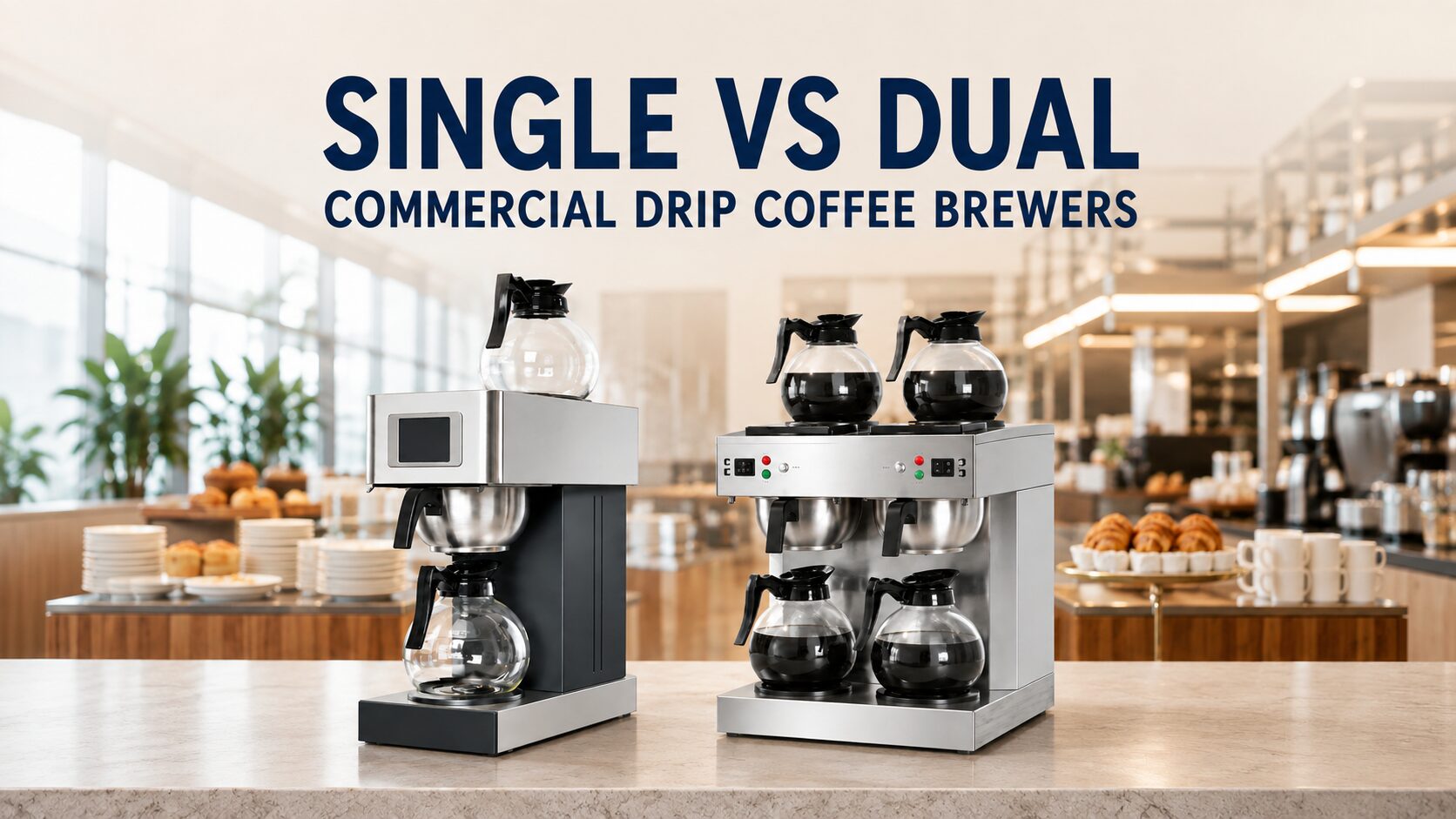
A single-station commercial drip coffee brewer prepares one batch at a time. A dual-station commercial drip coffee brewer can prepare two batches independently, allowing both sides to operate at the same time.
Both configurations can work well. The right choice depends on your peak-hour demand, service pattern, available counter space, water connection, electrical supply, and whether you need to serve more than one type of coffee.
This guide explains the practical differences between single and dual commercial drip coffee brewers and helps you decide which setup fits your business.
1. What Is a Single-Station Commercial Drip Coffee Brewer?
A single-station brewer has one brewing funnel and prepares one batch of coffee during each brewing cycle.
Depending on the machine design, brewed coffee may be collected in:
- a glass decanter
- a thermal Airpot
- a larger insulated serving container
Some single-station machines also have additional warming plates. This means one batch can brew while another decanter remains ready for service.
Single-station brewers are commonly used in:
- small and medium offices
- bakeries
- breakfast restaurants
- meeting rooms
- small hotel breakfast areas
- convenience counters
- cafés offering batch-brewed coffee
The main advantage is simplicity. The machine normally requires less counter space, has fewer controls, and is easier for staff to manage when demand is steady rather than highly concentrated.
2. What Is a Dual-Station Commercial Drip Coffee Brewer?
A dual-station brewer combines two independent brewing positions in one machine.
Each side has its own brewing funnel and control area. Depending on the model, operators can start both sides together or use only one side when demand is lower.
This configuration can provide several workflow advantages:
- two batches can be prepared at the same time
- regular and decaffeinated coffee can be brewed separately
- different roast profiles can be served without waiting
- staff can respond more quickly during breakfast or event peaks
- one side can remain available while the other side is being cleaned or refilled
Dual-station brewers are especially useful in fixed commercial coffee stations where repeated brewing happens during a short service period.
Typical applications include:
- hotel breakfast buffets
- busy restaurants and diners
- large offices
- conference and event facilities
- canteens and institutional dining
- catering preparation areas
- high-traffic self-service coffee stations
3. Single vs Dual Drip Coffee Brewer: Quick Comparison
| Comparison Point | Single-Station Brewer | Dual-Station Brewer |
|---|---|---|
| Brewing stations | One | Two independent stations |
| Batches prepared at one time | One | Up to two |
| Best demand pattern | Low to moderate or spread throughout the day | Moderate to high demand concentrated in peak periods |
| Coffee variety | Usually one coffee at a time | Two coffees can be brewed separately |
| Counter space | More compact | Requires more width and working space |
| Electrical demand | Usually lower | Usually higher; specifications must be confirmed |
| Operator workflow | Simple and easy to manage | Greater output and flexibility during busy service |
| Typical applications | Offices, bakeries, small restaurants and meeting rooms | Hotels, busy restaurants, events and large offices |
The comparison does not mean that every busy business automatically needs a dual brewer. A fast single brewer with suitable holding capacity may still meet demand. The decision should be based on the complete service workflow rather than the number of brewing stations alone.
4. Choose a Single-Station Brewer When Demand Is Steady
A single brewer is often the more practical choice when coffee consumption is distributed across the day.
For example, an office may serve coffee in the morning, after lunch, and during afternoon meetings. The total daily volume may be significant, but the machine does not need to prepare all of that coffee within the same hour.
A single-station brewer usually makes sense when:
- one batch can cover normal service demand
- staff have enough time to prepare the next batch
- only one type of coffee is normally served
- counter space is limited
- the coffee station may need to be moved
- installation simplicity is important
- fresh smaller batches are preferred over holding several pots
For these businesses, buying a larger dual-station machine may increase equipment and installation requirements without improving the actual customer experience.
5. Choose a Dual-Station Brewer When Peak Demand Creates Waiting
A dual-station brewer becomes useful when one brewing cycle cannot keep up with the busiest period.
Consider a hotel breakfast area. Coffee demand may remain low for most of the day but rise sharply between the beginning and end of breakfast service. Staff need to replace empty decanters quickly while guests continue arriving.
With two brewing stations, the operator can prepare two batches at the same time or stagger the cycles so that fresh coffee becomes available at shorter intervals.
A dual brewer is worth considering when:
- empty decanters frequently cause waiting during peak periods
- staff repeatedly start a new batch immediately after the previous cycle
- regular and decaffeinated coffee must be available together
- two service areas need coffee at the same time
- breakfast, lunch, meetings or events create concentrated demand
- the coffee station has enough permanent counter space
- the site has the required electrical and water connections
The benefit is not simply producing more coffee. It is reducing the operational gap between batches.
6. Compare Peak-Hour Workflow, Not Only Daily Cup Volume
One of the most common purchasing mistakes is choosing a brewer based only on total daily consumption.
A business serving 200 cups over ten hours has a different requirement from a business serving 120 cups during a one-hour breakfast rush.
Before selecting a machine, map the busiest service period:
- Estimate how many cups are needed during the peak hour.
- Confirm the serving size used by the business.
- Calculate how many servings one batch provides.
- Check how long one complete brewing cycle takes.
- Include time for replacing filter paper, adding coffee, moving decanters and cleaning.
- Decide how much coffee must remain ready while the next batch brews.
If a single brewer can complete the required number of cycles without creating empty service periods, it may be sufficient. If the workflow repeatedly reaches its limit, two independent brewing stations can provide a more reliable buffer.
For a more detailed capacity calculation, read our commercial drip coffee machine capacity guide.
7. Consider Decanter Positions and Coffee Holding
The number of brewing stations and the number of decanter positions are related, but they are not the same specification.
A single-station brewer may still have several warming plates. This allows staff to brew one batch while keeping other decanters ready for service.
A dual-station brewer may offer upper and lower decanter positions for both sides. This creates more flexibility during short demand peaks.
Additional positions can be useful for:
- regular coffee
- decaffeinated coffee
- different roast profiles
- separate dining and meeting-room service
- keeping a replacement pot ready before the serving pot becomes empty
However, more warming positions should not encourage staff to hold coffee for unnecessarily long periods. The goal is to support service flow while maintaining fresh coffee turnover.
8. Manual Fill or Automatic Water Filling?
Water filling has a major effect on how efficiently either machine type operates.
Manual-Fill Brewers
Manual filling provides flexible installation because the machine does not need a permanent water connection.
It works well when:
- brewing frequency is low to moderate
- the machine needs to be moved
- there is no suitable water line near the coffee station
- simple installation is a priority
Automatic-Fill Brewers
An automatic-fill brewer connects to the water supply and reduces the need for staff to measure and add water between batches.
This becomes more valuable when:
- multiple batches are brewed continuously
- staff need to manage other breakfast or restaurant duties
- the coffee station is permanently installed
- consistent workflow is more important than mobility
For a dual-station machine, automatic water filling can help the operator use both brewing sides efficiently. If both sides require frequent manual attention, the labor-saving benefit of dual brewing may be reduced.
9. Check Electrical, Plumbing and Counter Requirements
A dual-station machine is not simply a wider version of a single brewer. It may have significantly different installation requirements.
Electrical Supply
Before ordering, confirm:
- rated voltage
- frequency
- total wattage
- rated current
- plug type
- available electrical circuit
This is especially important for international buyers because electrical standards differ by country.
Water Connection
For automatic-fill models, check:
- water inlet size
- incoming water pressure
- water filtration requirements
- available shut-off valve
- local installation regulations
Water quality also matters. Appropriate filtration can help protect the brewer from mineral buildup and support more consistent coffee flavor.
Working Space
Measure more than the machine footprint. Operators also need room to:
- remove and refill the brewing funnels
- move hot decanters safely
- clean the warming plates
- access water and electrical connections
- store filter paper and ground coffee nearby
10. Which Brewer Fits Each Business Type?
| Business Type | Common Demand Pattern | Practical Starting Point |
|---|---|---|
| Small office | Several smaller demand periods across the day | Single-station brewer or Airpot brewer |
| Bakery | Regular smaller batches with moderate turnover | Single-station glass-decanter brewer |
| Small restaurant | Moderate breakfast and lunch peaks | Single station with additional warming positions |
| Medium or large office | Repeated weekday brewing and meeting demand | Automatic-fill single station or dual station |
| Hotel breakfast buffet | High demand concentrated in a short period | Dual-station or higher-capacity automatic-fill brewer |
| Conference center | Several service points prepared before scheduled events | Dual brewer with decanters or multiple Airpots |
| Busy diner | Continuous table service and fast pot turnover | Dual-station glass-decanter brewer |
| Catering operation | Large batches prepared for mobile service | Dual station, multiple Airpots or large batch brewer |
These are starting points rather than fixed rules. The final choice should be based on measured peak demand and the actual service workflow.
11. Example: Hotel Breakfast Coffee Service
Imagine a hotel that serves coffee throughout the day but experiences most demand during a two-hour breakfast period.
During quieter hours, one brewing station may be enough. During breakfast, however, staff may need to supply the buffet, refill table-service decanters, and prepare coffee for a meeting room at the same time.
A dual-station brewer can allow the hotel to:
- brew two batches together before the breakfast rush
- use one side for regular coffee and the other for decaf
- stagger the brewing cycles to maintain a fresher supply
- keep replacement decanters ready during the busiest period
If the hotel has a suitable water line, automatic filling can further reduce the number of steps required from the breakfast team.
But a smaller hotel with limited breakfast traffic may still be better served by a compact single-station brewer. The dual setup should solve a real workflow problem, not simply add unused capacity.
12. Example: Office Coffee Station
An office may have a similar number of daily coffee servings as a restaurant, but its demand pattern is usually different.
Employees may drink coffee when they arrive, after lunch, and during meetings. Because consumption is spread across several periods, a single-station brewer may have enough time to prepare each new batch.
A dual brewer may become useful when:
- the office has several departments using one coffee station
- large meetings regularly create sudden demand
- regular and decaffeinated coffee must always be available
- staff frequently wait for the next batch
For self-service offices, an Airpot system may also be worth considering because brewed coffee can be moved away from the machine and served without remaining on a warming plate.
13. Questions to Ask Before Buying
Before choosing between a single and dual commercial drip coffee brewer, ask:
- How many cups are required during the busiest hour?
- How many servings does one batch provide?
- How long does each brewing cycle take?
- Does the business serve regular and decaffeinated coffee together?
- How many decanters or Airpots need to remain ready?
- Is manual or automatic water filling more practical?
- Is a permanent water connection available?
- Does the electrical circuit support the machine?
- Is there enough space for safe operation and cleaning?
- Will the extra brewing station be used regularly?
Answering these questions will usually make the correct configuration much clearer.
14. CareforCafe Commercial Drip Coffee Brewer Options
CareforCafe supplies commercial drip coffee machines for offices, restaurants, hotels, bakeries, meeting rooms, buffets and other beverage-service applications.
Available configurations include single-station and dual-station brewing systems, glass-decanter and Airpot formats, manual and automatic water filling, and different holding arrangements for varying service volumes.
For example, the CareforCafe CB-D4042U2D uses two independent brewing stations and four decanter positions. It supports manual and automatic water filling and is designed for commercial locations that need more flexibility during peak coffee service.
International buyers should confirm the required voltage, frequency, plug, water connection, capacity, packaging and accessory configuration before ordering.
Explore our commercial coffee machine range or contact CareforCafe to discuss the right brewing setup for your market and customers.
Frequently Asked Questions
Is a dual commercial coffee brewer always faster?
A dual brewer can prepare two batches at the same time, so it can increase total brewing output when both stations are used. Actual performance still depends on batch size, brewing time, water supply, electrical power and operator workflow.
Can a dual brewer make two different coffees?
Yes. Independent brewing stations can be used for different coffees, such as regular and decaffeinated coffee, provided staff keep the funnels and decanters clearly separated.
Does a small hotel need a dual-station brewer?
Not necessarily. A small hotel with moderate breakfast demand may be well served by a single brewer with additional decanters or an Airpot. A dual brewer becomes more valuable when peak demand repeatedly exceeds the output of one station.
Is automatic water filling necessary for a dual brewer?
It is not always necessary, but automatic filling can reduce operator steps when both stations are used frequently. Manual filling may still be suitable when brewing volume is moderate or a permanent water connection is unavailable.
How many warming positions should a business choose?
The correct number depends on peak demand, how quickly coffee is served, and whether different coffee options are required. More warming positions improve service flexibility, but coffee should not remain heated for unnecessarily long periods.
Final Recommendation
Choose a single-station commercial drip coffee brewer when demand is low to moderate, coffee service is spread across the day, counter space is limited, and one batch at a time can maintain service.
Choose a dual-station commercial drip coffee brewer when the business regularly needs two batches at once, peak periods create waiting, multiple coffee types must be available, or several service points need coffee at the same time.
The best machine is not automatically the one with the most brewing stations. It is the one that matches the real peak-hour workflow while maintaining reliable service, practical installation and fresh coffee turnover.