
Choosing a commercial drip coffee machine is not only a question of batch size. A hotel breakfast buffet, an office meeting room, and a catering operation may all serve filter coffee, but they do not serve it in the same way.
The right equipment depends on the timing of demand, the number of serving points, how long coffee must be held, whether the brewer is installed permanently, and how quickly staff can prepare the next batch.
This guide explains how to match a commercial coffee brewer to three common service scenarios: breakfast, meetings, and catering.
Quick Comparison: Three Service Scenarios
| Scenario | Typical Demand Pattern | Main Equipment Priority | Recommended Serving Method |
|---|---|---|---|
| Hotel or restaurant breakfast | High demand concentrated in a short morning period | Fast repeat brewing, multiple serving positions, simple staff operation | Glass decanters, thermal servers, or Airpots according to the service layout |
| Office meetings | Smaller batches prepared at scheduled times | Flexible installation, easy operation, portable serving | Thermal server or Airpot that can be moved into the meeting room |
| Catering and events | Demand changes by event size and serving schedule | Scalable batch production, transport, heat retention, backup capacity | Multiple thermal servers or insulated serving containers |
1. Start With the Service Pattern, Not the Machine Size
Buyers often begin by comparing liters per batch. Capacity is important, but it does not show the complete workflow.
Before comparing machines, confirm:
- How many cups are needed during the busiest 15, 30, or 60 minutes?
- Will demand arrive steadily or all at once?
- Will coffee be served beside the brewer or moved to another location?
- How many coffee varieties must be available at the same time?
- Can staff refill water manually, or is a fixed water connection available?
- What voltage, power, and plug configuration are available at the installation site?
These questions help determine whether you need a compact single-station brewer, a machine with multiple warming positions, a dual-station brewer, or a larger batch brewer.
2. Choosing a Brewer for Hotel and Restaurant Breakfast Service
Breakfast demand is usually concentrated. Guests often arrive in waves, and an empty serving station during the peak period immediately affects the service experience.
For this scenario, focus on:
- Repeat brewing speed: Staff should be able to start the next batch without disrupting service.
- Multiple serving positions: Extra decanter or server positions allow one batch to be served while another is prepared.
- Simple controls: Different employees may operate the brewer during the week.
- Practical cleaning: Funnels, serving containers, and contact areas should be easy to remove and clean.
- Peak-hour backup: A spare decanter or thermal server can prevent delays between batches.
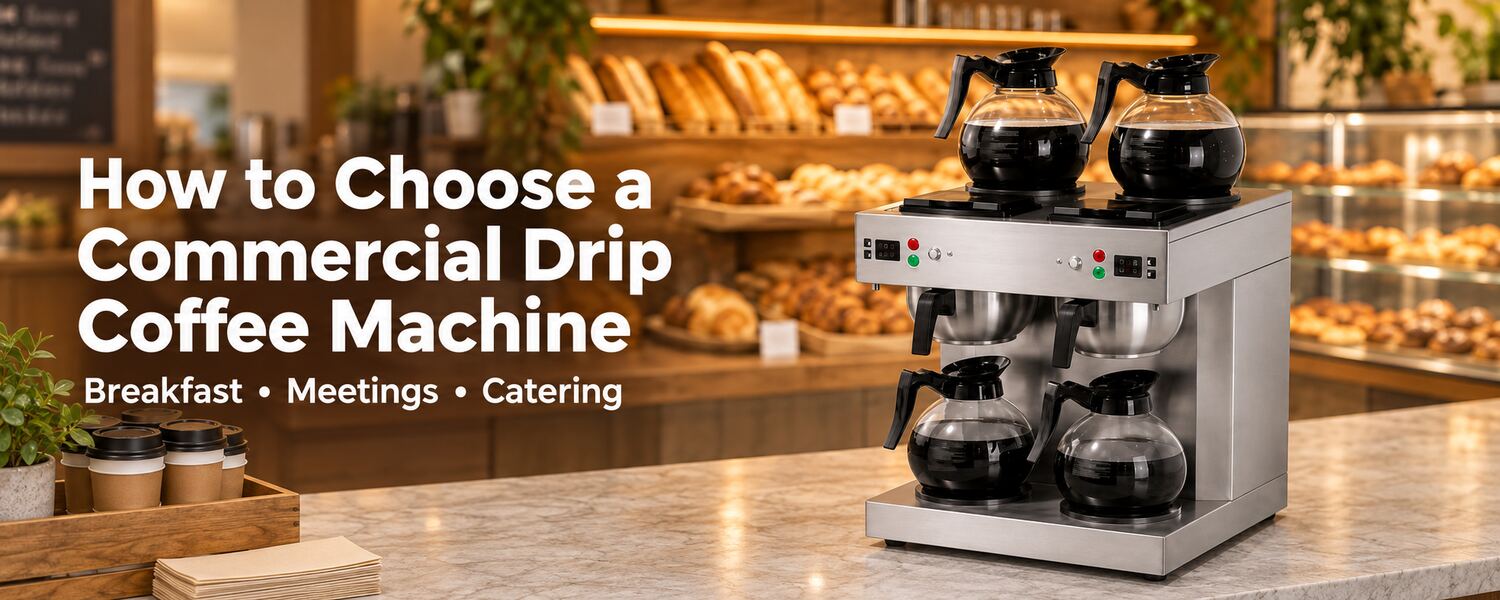
A dual-station commercial drip coffee machine can be useful when the location needs two batches at the same time or wants to offer regular and decaffeinated coffee separately. For example, the CareforCafe CB-D4042U2D uses two independent brewing stations and four decanter positions, supporting busy breakfast counters and other concentrated service periods.
3. Choosing a Brewer for Office Meetings
Office coffee demand is often planned around a meeting schedule. The brewer may stay in a pantry, while the coffee is served in a conference room.
In this case, the complete system matters more than the brewer alone. Consider:
- a manageable batch size that matches the number of attendees;
- manual filling when no fixed water connection is available;
- a thermal server or Airpot that can be carried to the meeting room;
- simple operation for administrative or hospitality staff;
- a compact footprint for pantry counters.
A smaller commercial filter coffee machine can be more practical than an oversized high-output brewer if meetings are scheduled and the number of guests is predictable. The goal is to prepare enough fresh coffee without leaving a large unused batch for a long period.
4. Choosing a Brewer for Catering and Events
Catering work creates a different challenge because the brewing point and serving point may not be the same. Coffee may need to be prepared in a kitchen, moved to a banquet room, or delivered to an off-site event.
Important factors include:
- Scalable production: The system should support back-to-back batches when the guest count increases.
- Heat retention: Thermal servers and insulated containers are usually more practical than open warming plates during transport.
- Transport safety: Check lids, handles, spigots, and the stability of the serving container.
- Multiple serving points: One event may require separate coffee stations.
- Backup planning: Extra servers make it easier to rotate full and empty containers.
For catering buyers, a brewer and serving-container package should be evaluated as one system. A high-capacity brewer is not enough if coffee cannot be moved and served efficiently.
5. Estimate Capacity Without Guessing
Use the busiest service period as the starting point. A simple planning method is:
- Estimate the number of cups required during the peak period.
- Confirm the actual cup size used by the business.
- Calculate the total beverage volume required.
- Compare this demand with the brewer's batch size and brewing cycle.
- Add realistic time for grinding, loading the filter, moving servers, and cleaning between service periods.
Do not calculate capacity from the full operating day alone. A business may serve a reasonable total number of cups but still need higher output because most orders arrive within one short period.
6. Confirm Water, Power, and Installation Requirements
Before ordering any commercial coffee brewer, confirm the installation conditions.
- Water supply: Manual-fill models offer flexible placement. Automatic-fill models are more convenient for frequent brewing but require a suitable water connection.
- Voltage and power: Match the machine configuration to the destination country's electrical supply.
- Plug: Confirm the required plug type before production.
- Counter space: Check the product dimensions and leave working space for the funnel, servers, water connection, and cleaning.
- Drainage and filtration: Review local water quality and installation requirements with the equipment supplier.
These details should be confirmed from the model specification sheet rather than assumed from the product photo.
7. Choose the Serving System Together With the Brewer
The receiving container changes how the coffee station works.
- Glass decanters make the coffee level visible and work well for nearby counter service.
- Thermal servers support table service, buffet stations, and locations where coffee must be moved.
- Airpots are useful for self-service areas and meeting rooms.
- Larger insulated servers can support catering and high-volume service.
Check whether serving containers are included, optional, or sold separately. Also confirm compatibility, capacity, lid type, handle design, and replacement availability.
8. A Practical Procurement Checklist
Before requesting a final quotation, confirm the following information for the selected model:
- brewing capacity and expected serving volume;
- voltage, power, frequency, and plug;
- manual-fill, automatic-fill, or dual water-filling option;
- product dimensions and packing dimensions;
- compatible decanter, Airpot, or thermal server;
- included accessories and optional accessories;
- cleaning and daily operating requirements;
- sample configuration and packaging requirements.
Conclusion
The best commercial drip coffee machine is the one that fits the actual service pattern. Breakfast operations need reliable peak-hour flow. Meeting rooms need flexible, portable service. Catering operations need scalable production and effective heat retention.
CareforCafe supplies commercial drip coffee brewers and compatible serving solutions for hotels, restaurants, offices, distributors, and catering projects. Share your target market, expected peak demand, water connection, electrical requirements, and preferred serving method with our team so we can help you compare suitable configurations.
Need help selecting a brewer? Contact CareforCafe with your application and required capacity to discuss available commercial filter coffee machine options.