
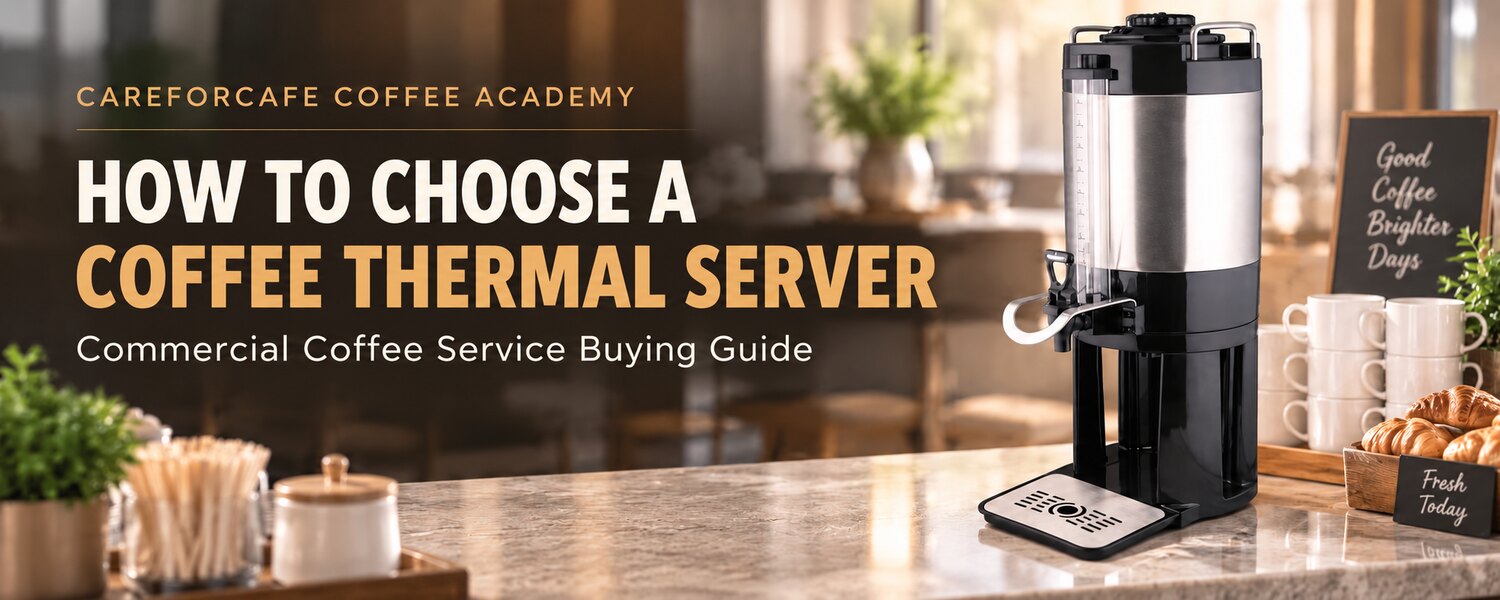
A coffee thermal server is a practical part of many commercial coffee and tea service setups. It allows staff to prepare a batch at the brewing station, move it to the service area and dispense drinks during the required service period. This can be useful in hotels, restaurants, offices, conference venues, catering operations and other locations where the brewing point and serving point are not the same.
However, products that look similar may be designed for very different uses. Some are insulated servers, some are electrically heated coffee urns, and others are hot-water boilers. Before comparing prices, buyers should first define the beverage, service volume and operating workflow.
1. Start With the Actual Service Application
The right commercial coffee thermal server depends on where it will be used and how customers will be served. A hotel breakfast buffet may need fast self-service during a short peak period, while an office meeting room may prioritize compact placement and simple refilling. Catering teams may need a unit that can be transported between preparation and serving areas.
Before selecting a product, confirm:
- The intended location: hotel, restaurant, office, conference center or catering service
- Whether staff or guests will operate the spigot
- The expected servings during the busiest period
- How far the dispenser will be placed from the brewing station
- How often staff can refill, clean and check the unit
This information is more useful than choosing a dispenser from capacity alone.
2. Confirm the Beverage and Holding Method
A coffee thermal server may be used for brewed coffee, tea or another prepared beverage, depending on its material, seals and supplier instructions. Buyers should confirm the intended beverage before ordering, especially when the same unit may be used across different service periods.
A coffee thermal server is intended to slow temperature change without continuously heating the beverage. This can support flexible placement and reduce the need for a power connection at the serving point. It is different from an electric coffee urn or hot-water boiler, which uses heating components and serves a different operating purpose.
Ask the supplier to explain the recommended beverage, preparation temperature, expected holding conditions and cleaning method for the exact model. Avoid relying on a general claim that applies to a product family but has not been confirmed for the selected unit.
3. Choose Capacity From Peak Demand and Refill Frequency
Capacity should match the busiest service window, not only the total number of drinks served in one day. A large dispenser may reduce refilling, but it also occupies more counter space and may hold a partially used batch for longer. A smaller unit may be easier to handle, but staff may need to refill it during the busiest period.
Use a simple calculation:
- Estimate the number of servings during the peak service period.
- Multiply the serving count by the average cup volume.
- Add a reasonable operating margin.
- Compare the result with the number of refills staff can complete.
For multi-station service, two moderate-capacity dispensers may sometimes provide a more practical workflow than one very large unit. They can also allow different beverages or service areas to operate independently.
4. Check Insulation and Stainless-Steel Construction
For commercial use, buyers should examine more than the exterior appearance. The body, inner beverage-contact area, lid, seals, handles and supporting base all affect daily operation.
Important points to confirm include:
- Whether the beverage-contact surfaces are suitable for the intended use
- The construction and finish of the stainless-steel body
- How the insulated structure is assembled
- Whether the lid closes securely and can be removed for cleaning
- Whether the unit remains stable when customers operate the faucet
- Whether the handle and base support normal transport and placement
Temperature-retention claims should be compared only when the test conditions are available. Starting temperature, room temperature, fill level, lid position and test duration can all affect the result.
5. Evaluate the Spigot, Sight Glass and Drip Tray
The dispensing components directly affect the customer and staff experience. A beverage dispenser with spigot should provide controlled flow and be positioned with enough clearance for the intended cups or containers.
Check the following during sample evaluation:
- Whether the spigot opens and closes smoothly
- Whether flow can be controlled without excessive splashing
- Whether the faucet drips after closing
- Whether cups fit comfortably beneath the outlet
- Whether a sight glass or liquid-level indicator is easy to read
- Whether the drip tray can be removed, emptied and cleaned
- Whether the complete unit remains stable during dispensing
A visible level indicator can help staff plan refills, but it also creates additional parts that must be cleaned and checked. Buyers should ask how the tube, connections and seals are maintained.
6. Plan Daily Cleaning Before Buying
Coffee oils, tea residue and beverage deposits can affect taste and hygiene if the dispenser is difficult to clean. The cleaning routine should be clear enough for the staff who will use the equipment every day.
Confirm which parts are removable and how to clean:
- The inner container
- The lid and sealing components
- The spigot and internal flow path
- The sight glass and its connections
- The drip tray and cup area
- The exterior stainless-steel surface
Ask whether cleaning tools, replacement seals, faucet parts or operating instructions are available. For distributors and project buyers, spare-parts planning should be discussed before the bulk order rather than after an issue appears.
7. Coffee Thermal Server vs Coffee Urn vs Hot-Water Boiler
| Equipment type | Main purpose | Typical service role |
|---|---|---|
| Coffee thermal server | Hold and dispense a prepared beverage while slowing temperature change | Buffets, meeting rooms, catering stations and self-service counters |
| Coffee urn | Brew and/or actively hold a larger quantity of coffee, depending on the model | High-volume coffee preparation and service |
| Hot-water boiler | Heat and dispense water | Tea, instant beverages and foodservice preparation |
The three categories should not be treated as interchangeable. Buyers should choose the equipment type according to whether they need brewing, active heating, hot-water production or insulated holding.
8. Questions for a Supplier or OEM Project
Before approving a sample or placing a bulk order, confirm the following:
- Available capacities and external dimensions
- Recommended beverages and operating conditions
- Construction of the inner container and outer housing
- Temperature-retention test conditions
- Spigot, sight-glass and drip-tray configuration
- Cleaning instructions and removable components
- Included accessories and spare parts
- Carton dimensions, loading quantity and packaging method
- Logo, color, label, manual and packaging options for OEM or ODM orders
- Inspection procedure before shipment
For a distributor or hospitality project, the approved sample should match the final written specification. Any change to materials, accessories, branding or packaging should be confirmed separately before production.
Final Takeaway
The best coffee thermal server is the one that fits the real service workflow. Capacity, refill frequency, insulation, stainless-steel construction, spigot performance, level visibility and cleaning access should all be reviewed together.
CareforCafe supplies commercial beverage equipment for hospitality buyers, distributors and OEM/ODM projects. Share your intended beverage, service location, required capacity, expected order quantity and destination market with our team so we can discuss a suitable coffee thermal server configuration.