
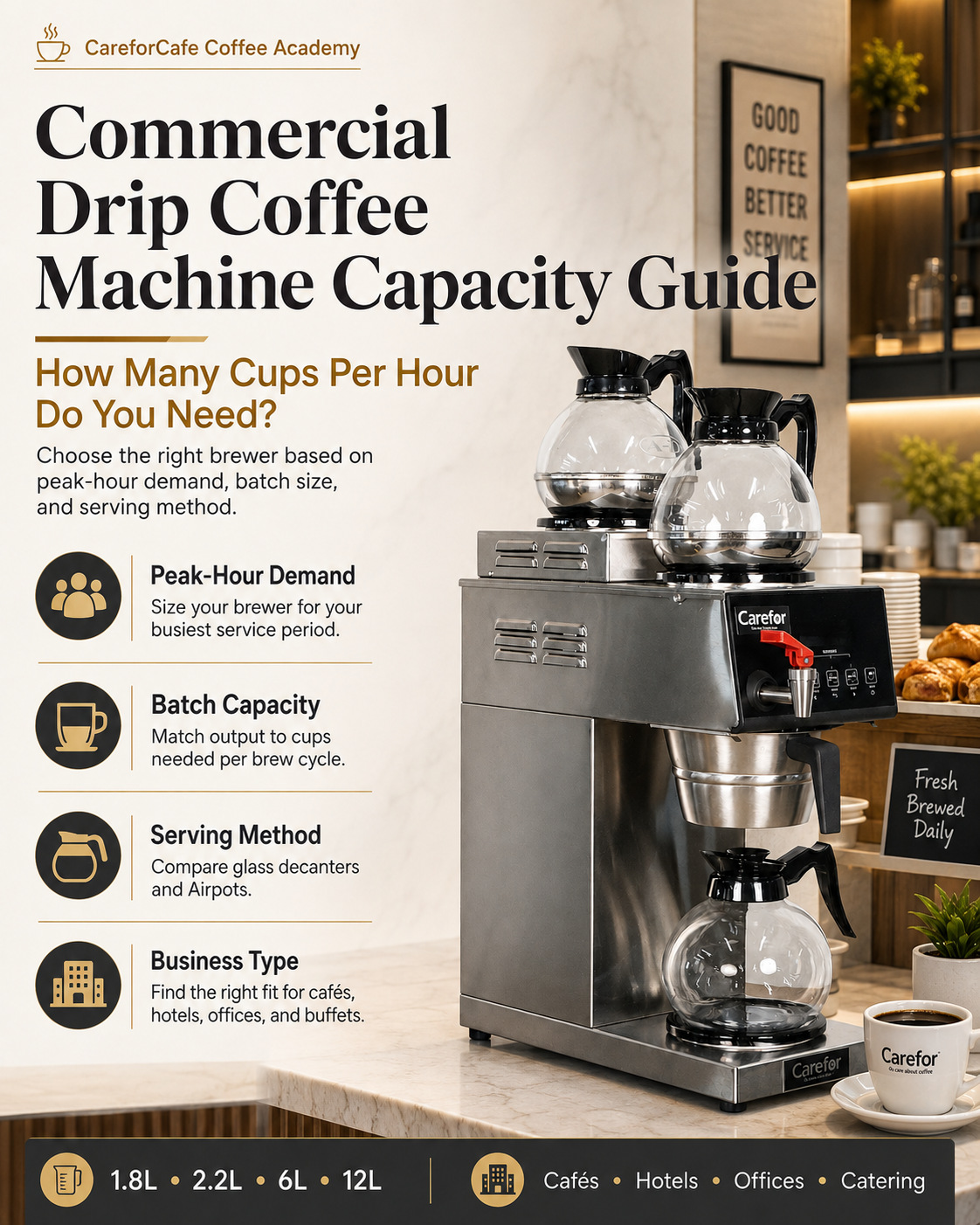
Commercial Drip Coffee Machine Capacity Guide: How Many Cups Per Hour Does Your Business Need?
Choosing a commercial drip coffee machine is not only about selecting a larger or more powerful brewer.
The more important question is:
How much coffee does your business need during its busiest service period?
A small office, a restaurant breakfast service, a hotel buffet, and a conference center may all use drip coffee machines, but their required brewing capacity can be very different.
Choosing too little capacity can create waiting time, repeated brewing, and empty coffee stations during peak hours. Choosing far more capacity than you actually need can increase equipment cost, take up unnecessary counter space, and leave brewed coffee sitting for too long.
This guide explains how to estimate commercial coffee demand and choose the right brewer based on batch size, cups per hour, holding method, water supply, and peak-hour workflow.
1. What Does Commercial Coffee Brewer Capacity Actually Mean?
When comparing commercial drip coffee machines, buyers often see specifications such as:
- 1.8L brew capacity
- 2.2L brew capacity
- 6L batch size
- 12L capacity
- multiple warming plates
- one, two, or three glass decanters
However, these numbers do not all mean the same thing.
There are several different types of capacity to consider.
Batch Size
Batch size is the amount of coffee brewed during one brewing cycle.
For example:
- A 1.8L brewer produces approximately one standard glass decanter per batch.
- A 2.2L brewer may be designed for a larger thermal Airpot.
- A 6L or 12L batch brewer is designed for much higher-volume coffee service.
Batch size tells you how much coffee is produced at one time, but it does not automatically tell you how much coffee can be produced in one hour.
Brewing Speed
The second factor is the time required to complete each brewing cycle.
Two machines with the same 1.8L batch capacity can have very different hourly output if one completes brewing faster than the other.
A simple theoretical calculation is:
Hourly Coffee Output = Batch Volume × Number of Brewing Cycles per Hour
For example, if a machine brews one batch every six minutes, it could theoretically complete approximately ten batches per hour.
Actual output may be lower because operators also need time for:
- filling water
- replacing coffee grounds
- changing filter paper
- moving decanters
- cleaning
- serving customers
For this reason, businesses should not select a machine based only on theoretical maximum output.
Holding Capacity
Another important factor is how much finished coffee can be kept ready for service.
A brewer may produce only one batch at a time but support several containers.
For example, a commercial brewer with multiple warming plates may allow:
- one decanter to be served
- one decanter to remain hot
- another batch to be prepared
This can greatly improve peak-hour workflow without necessarily increasing the brewer's batch size.
2. Start With Peak-Hour Demand, Not Daily Coffee Consumption
One of the most common mistakes when choosing a commercial coffee brewer is looking only at total daily consumption.
Suppose a hotel serves 300 cups of coffee per day.
That does not necessarily mean it needs an extremely large coffee brewer.
If those 300 cups are spread evenly across 12 hours, demand is relatively manageable.
But if 180 of those cups are consumed between 7:00 a.m. and 9:00 a.m. during breakfast, the brewing requirement becomes very different.
The machine must therefore be sized around peak demand, not simply total daily volume.
A useful starting formula is:
Peak-Hour Cups = Number of Customers × Coffee Participation Rate × Average Cups per Coffee Drinker
Then add additional capacity for unexpected demand.
3. How Many Cups Are in One Batch?
Cup size can vary significantly between businesses, so it is important to define what you mean by "one cup."
For planning purposes, approximately 180 mL / 6 oz per serving can be used as a practical reference.
Using that serving size:
| Brew Capacity | Approximate 180 mL Servings per Batch |
|---|---|
| 1.8L | About 10 cups |
| 2.2L | About 12 cups |
| 4.0L | About 22 cups |
| 6.0L | About 33 cups |
| 12.0L | About 66 cups |
These figures are planning references rather than guaranteed machine output.
Actual serving size may be smaller or larger depending on the market and application.
For example, a restaurant serving coffee in 150 mL cups will get more servings from the same batch than a hotel using 250 mL mugs.
4. Small-Volume Commercial Coffee Service
For lower-volume businesses, a compact 1.8L commercial drip coffee machine may already provide enough capacity.
Typical applications include:
- small offices
- bakeries
- breakfast restaurants
- meeting rooms
- small cafés offering batch coffee
- convenience counters
- reception areas
A 1.8L batch provides approximately ten 180 mL servings.
If demand is spread throughout the day, the operator can simply prepare another batch when the previous decanter begins running low.
When a 1.8L Brewer Makes Sense
A smaller brewer is especially practical when:
- customer traffic is relatively predictable
- coffee is consumed throughout the day rather than all at once
- counter space is limited
- no large breakfast or event rush occurs
- fresh coffee turnover is more important than storing large volumes
For these applications, buying a 6L or 12L brewer may add unnecessary capacity.
5. When Multiple Glass Decanters Become Useful
As demand increases, the next step does not necessarily have to be a much larger brewing tank.
Adding additional glass decanters and warming positions can significantly increase serving flexibility.
Commercial drip coffee machines are commonly available with:
- one serving position
- two warming positions
- three warming positions
This allows businesses to prepare coffee ahead of short peak periods.
For example, during restaurant breakfast service, one decanter can be actively served while another remains ready on a warming plate.
A three-decanter setup offers even more flexibility.
Multiple Decanters Can Also Support Different Coffees
Businesses may use separate decanters for:
- regular coffee
- decaffeinated coffee
- different roast profiles
This makes multiple warming positions useful even when total volume is not extremely high.
6. When Automatic Water Filling Becomes Important
Manual-fill coffee brewers can be very practical at lower and moderate volumes.
They do not require a permanent water connection, which makes installation easier and allows greater flexibility in where the brewer is placed.
However, repeated manual filling can become inefficient when coffee demand increases.
This is where an automatic water filling commercial coffee brewer becomes more useful.
A machine connected directly to the water supply can reduce operator intervention between batches.
Manual-Fill Brewers Are Usually Better When:
- coffee demand is low to moderate
- installation flexibility is important
- there is no available water line
- the machine may need to be moved
- the customer wants simple operation
Automatic-Fill Brewers Are Usually Better When:
- multiple batches are brewed continuously
- breakfast or lunch periods create concentrated demand
- staff need to reduce preparation steps
- a permanent coffee station is available
- the location has a suitable water connection
For busy hotels, restaurants, offices, and institutional coffee stations, automatic filling can make a major difference to workflow even when the actual batch size remains relatively small.
7. Glass Decanter or Airpot: Capacity Is Not the Only Question
Businesses also need to decide how the brewed coffee will be held and served.
Two common systems are glass decanters and thermal Airpots.
Glass Decanter Brewers
Glass decanters work well when coffee is consumed relatively quickly.
They are common in:
- restaurants
- diners
- cafés
- small hotels
- offices with frequent coffee turnover
The decanter sits on a warming plate that keeps the coffee hot.
This setup makes it easy for staff to see how much coffee remains and quickly replace an empty pot.
Airpot Coffee Brewers
Airpots are insulated containers designed to maintain serving temperature without continuously sitting on a heating plate.
They are particularly useful for:
- hotel breakfast stations
- meeting rooms
- conference facilities
- offices
- buffet service
- self-service stations
- catering
An Airpot can also be moved away from the brewer after coffee has been prepared.
This means the brewing station and serving station do not have to be in the same location.
For businesses serving coffee over a longer period or across multiple service points, an Airpot brewer may therefore be more practical than a conventional glass-decanter setup.
8. When Should You Move to a 6L or 12L Batch Brewer?
Once demand becomes high enough, repeatedly brewing small 1.8L batches may no longer be efficient.
Large-capacity commercial batch brewers are designed for businesses that need substantial amounts of coffee within short service windows.
Typical applications include:
- large hotels
- banquet halls
- conference centers
- catering operations
- institutional dining
- hospitals
- universities
- large offices
- high-volume breakfast operations
A 6L batch represents approximately 33 servings at 180 mL each.
A 12L batch represents approximately 66 servings.
The advantage is straightforward: considerably more coffee can be prepared in each brewing cycle.
But bigger is not automatically better.
If a business only serves 20 cups every morning, preparing a 12L batch would create unnecessary waste and could reduce freshness.
High-capacity brewers make the most sense when large numbers of customers need coffee within a relatively short period.
9. Example Capacity Planning by Business Type
The following examples can help buyers understand how different commercial environments may approach capacity.
| Business Type | Typical Demand Pattern | Suitable Brewer Type |
|---|---|---|
| Small office | Low volume throughout the day | 1.8–2.2L manual brewer |
| Small restaurant | Moderate volume with breakfast/lunch peaks | 1.8L glass-decanter brewer |
| Bakery | Regular smaller batches | Glass-decanter brewer |
| Medium office | Repeated weekday consumption | Automatic-fill or Airpot brewer |
| Hotel breakfast area | High demand during a short period | Multiple-decanter or Airpot brewer |
| Conference room | Coffee prepared before meetings | Airpot brewer |
| Large hotel buffet | High concentrated demand | Automatic-fill / high-capacity batch brewer |
| Catering operation | Large batches and mobile serving | Airpot or 6L+ brewer |
| Institutional dining | Continuous high-volume service | 6L–12L commercial batch brewer |
There is no universal capacity that works for every business.
The correct choice depends on both volume and workflow.
10. Example: Choosing a Brewer for a 100-Guest Hotel Breakfast
Consider a hotel serving 100 guests during breakfast.
Suppose approximately 60 guests drink coffee, and each coffee drinker consumes an average of 1.5 cups.
The breakfast period would require approximately:
60 × 1.5 = 90 cups
If most guests arrive within one hour, the brewer needs to support approximately 90 servings during that peak.
A single 1.8L batch provides only about ten 180 mL servings.
That does not automatically mean a 1.8L brewer cannot work.
The hotel could use:
- repeated fast brewing
- multiple glass decanters
- several Airpots
- automatic water filling
But if the coffee station is consistently busy every morning, moving to a larger batch system can simplify service considerably.
This illustrates why cups per hour and workflow need to be considered together.
11. Example: Choosing a Brewer for an Office
An office may have 50 employees but very different demand from a 50-seat restaurant.
Coffee consumption might be spread across:
- early morning
- mid-morning
- after lunch
- afternoon meetings
Because demand is distributed throughout the day, a compact commercial drip brewer may provide sufficient capacity.
An Airpot can also work well because employees can serve themselves without keeping a glass decanter continuously on a warming plate.
So even though an office and restaurant may have a similar number of people, they may require completely different brewing setups.
12. Don't Forget the Recovery and Workflow Between Batches
When comparing commercial drip coffee machines, ask more than:
"How large is the water tank?"
Also ask:
- How much coffee is brewed per batch?
- How long is one brewing cycle?
- How quickly can the next batch begin?
- Is water filled manually or automatically?
- How many decanters or Airpots can be used?
- Can one batch brew while another is being served?
- How much coffee must be available during peak demand?
These questions provide a much more realistic picture of commercial capacity.
13. Other Factors That Affect the Right Machine Size
Capacity is important, but it should never be the only purchasing criterion.
Counter Space
Larger machines require more installation space.
Check:
- machine width
- depth
- height
- overhead clearance
- space needed to remove the filter basket
- space for decanters or Airpots
Electrical Requirements
Higher-capacity equipment may require higher electrical power.
Before purchasing, confirm:
- rated voltage
- frequency
- wattage
- current
- plug type
- available electrical circuit
This becomes especially important for international buyers because electrical standards vary between markets.
Water Connection
Automatic-fill brewers require suitable plumbing.
Buyers should confirm:
- water inlet connection
- incoming water pressure
- filtration requirements
- drainage requirements, if applicable
Poor water quality can also affect coffee flavor and create mineral buildup inside brewing equipment.
Coffee Freshness
More brewing capacity is not always better.
If coffee remains unused for long periods, quality can decline.
The ideal system should allow staff to brew enough coffee to meet demand without consistently producing large amounts of excess coffee.
For many businesses, frequent appropriately sized batches are better than one oversized batch.
14. How Much Extra Capacity Should a Business Allow?
It is usually risky to purchase a machine that can only meet normal demand with no reserve.
Demand can change because of:
- group bookings
- conferences
- seasonal hotel occupancy
- weekend traffic
- special events
- unexpected customer peaks
A commercial brewer should therefore provide some additional capacity above normal peak usage.
However, the goal is not to buy the largest machine available.
The goal is to create enough buffer so that staff can handle temporary demand increases without constantly waiting for the next batch.
15. One Large Brewer or Several Smaller Brewers?
For some businesses, two smaller commercial coffee brewers may be more practical than one very large machine.
Multiple machines can provide:
- backup if one machine requires maintenance
- separate regular and decaf coffee
- coffee service in different locations
- greater flexibility during peak periods
A hotel, for example, may use one brewer in the main breakfast area and another for conference service.
On the other hand, a centralized catering operation may benefit more from one high-capacity batch brewer.
The correct solution depends on how coffee moves through the business.
16. Matching Commercial Drip Coffee Brewer Capacity to Your Business
A useful way to think about commercial drip coffee equipment is to divide requirements into four broad levels.
Low-Volume Service
Consider:
- 1.8L glass-decanter brewer
- manual water filling
- one or two warming positions
Suitable for small restaurants, offices, bakeries, and meeting areas.
Moderate-Volume Service
Consider:
- automatic water filling
- multiple warming positions
- additional decanters
- 1.8–4L brewing systems
Suitable for restaurants, offices, hotels, and regular breakfast service.
Medium-to-High Volume With Self-Service
Consider:
- thermal Airpot brewer
- multiple Airpots
- automatic water filling where appropriate
Suitable for hotels, conferences, offices, buffets, and self-service coffee stations.
High-Volume Service
Consider:
- 6L or larger batch brewing
- automatic water filling
- thermal servers
- high brewing output
Suitable for large hotels, catering operations, institutions, banquet facilities, and other high-demand locations.
17. Commercial Drip Coffee Machines from CareforCafe
CareforCafe supplies commercial drip coffee brewing equipment for different levels of food-service and hospitality demand.
Our drip coffee brewer range includes:
- compact commercial glass-decanter brewers
- manual-fill coffee brewers
- automatic water-fill brewers
- one-, two-, and three-decanter configurations
- thermal Airpot brewers
- high-capacity commercial batch brewers
Different configurations are available for applications such as:
- cafés
- restaurants
- hotels
- offices
- breakfast areas
- conference facilities
- catering
- institutional beverage service
For distributors and commercial equipment buyers, product configuration can also vary depending on target-market voltage, capacity, installation requirements, and project needs.
Frequently Asked Questions
How many cups can a 1.8L commercial coffee brewer make?
Using a 180 mL serving as a reference, a 1.8L batch provides approximately 10 cups of coffee.
The actual number depends on the serving size used by the business.
How many cups can a 6L coffee brewer make?
A 6L batch provides approximately 33 servings at 180 mL each.
For smaller cups, the number of servings will be higher.
How many cups can a 12L commercial brewer make?
A 12L batch provides approximately 66 servings at 180 mL each.
Large-batch brewers are generally more suitable for hotels, catering, conferences, and institutional service than small offices or low-volume restaurants.
Is a bigger commercial coffee brewer always better?
No.
An oversized brewer may produce more coffee than customers can consume while it is fresh.
The best machine should be sized around peak-hour demand, brewing frequency, holding method, and service workflow.
Is an automatic-fill coffee brewer better than a manual-fill brewer?
Not necessarily.
Manual-fill machines are simple to install and work well for low-to-moderate demand.
Automatic-fill machines become more useful when staff need to brew multiple batches frequently because they reduce the need to refill the machine manually between brewing cycles.
Is an Airpot better than a glass coffee decanter?
It depends on how the coffee is served.
Glass decanters are practical when coffee turnover is fast and staff serve directly from a warming station.
Airpots are better suited to longer holding periods, self-service areas, meetings, buffets, and situations where coffee needs to be moved away from the brewer.
How do I calculate the commercial coffee machine capacity I need?
Start with the busiest hour of service.
Estimate:
Number of customers × percentage who drink coffee × average number of cups
Then compare the result with the brewer's:
- batch size
- brewing time
- number of serving containers
- holding capacity
Allow additional capacity for unexpected peaks.
Conclusion
Choosing the right commercial drip coffee machine is ultimately a question of matching brewing capacity to real customer demand.
A small business may only need a compact 1.8L brewer, while a busy hotel breakfast service may benefit from multiple decanters, Airpots, automatic water filling, or a much larger batch brewer.
Before choosing a machine, determine:
- your peak-hour coffee demand
- average serving size
- desired batch size
- brewing frequency
- glass decanter or Airpot requirements
- manual or automatic water filling
- available electrical and plumbing connections
- counter space
Once those requirements are clear, selecting the correct commercial coffee brewer becomes much easier.
Looking for a commercial drip coffee machine for your market or project?
CareforCafe offers commercial drip coffee brewers ranging from compact decanter machines to automatic-fill and high-capacity batch brewing systems.
Contact us for product specifications, wholesale pricing, and OEM/ODM cooperation.