
Choosing the correct commercial espresso machine is not only about appearance, price, or the number of group heads. The right machine should match your expected drink volume, busiest service period, available counter space, staff structure, and beverage menu.
For many buyers, the main decision is whether to purchase a single-group or two-group commercial espresso machine.
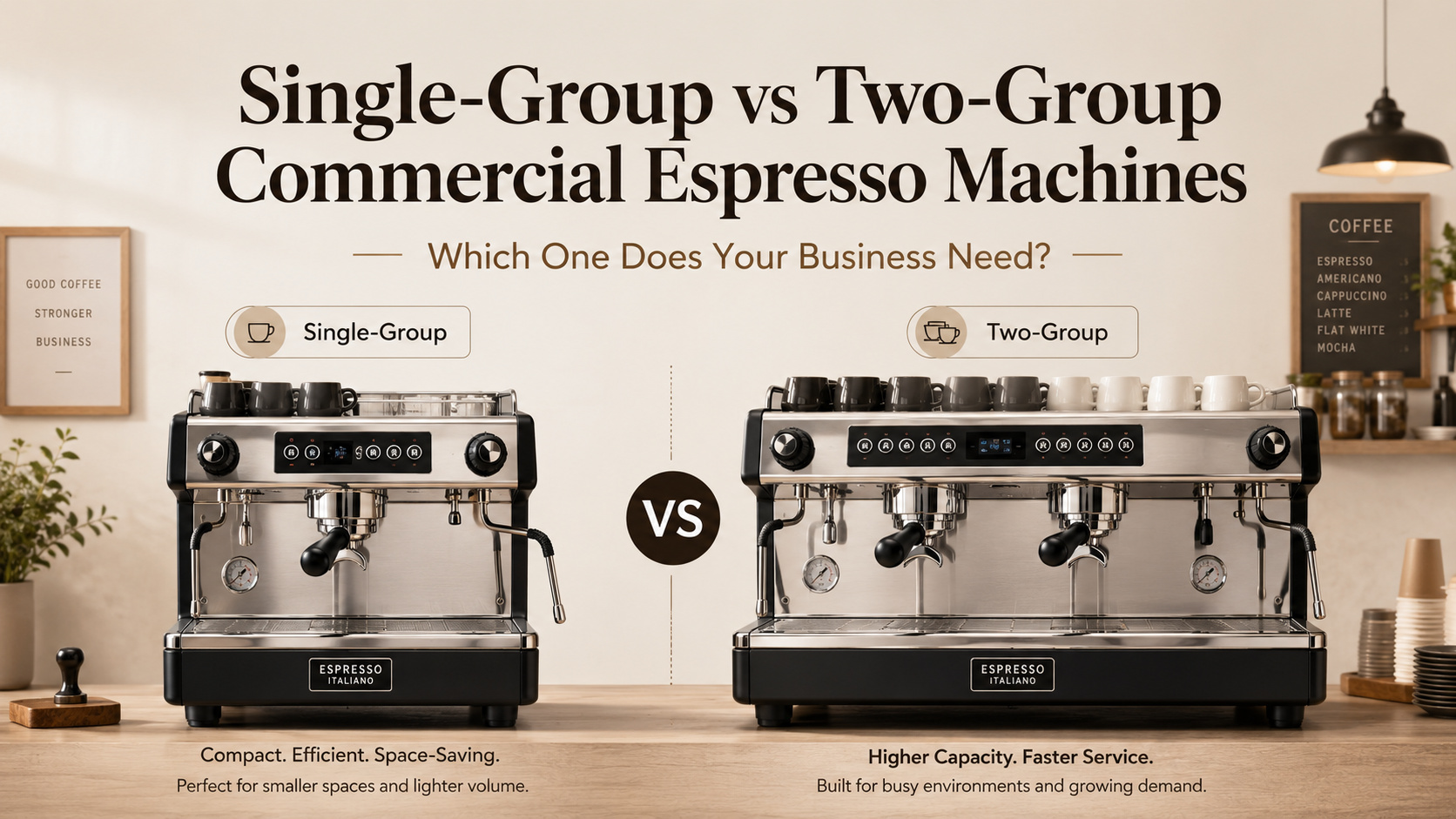
A single-group machine is compact, easier to position, and often suitable for businesses with moderate espresso demand. A two-group machine provides more brewing capacity and a more flexible workflow, making it better suited to cafés, restaurants, hotels, bakeries, and coffee bars with heavier peak-hour demand.
However, a two-group machine is not automatically the better choice. Buying more capacity than your business needs can increase equipment cost, utility requirements, counter-space usage, and maintenance responsibilities.
This guide compares single-group vs two-group commercial espresso machines to help you select the right configuration for your business.
What Is a Group Head on an Espresso Machine?
The group head is the part of the espresso machine where the portafilter is locked into place during brewing.
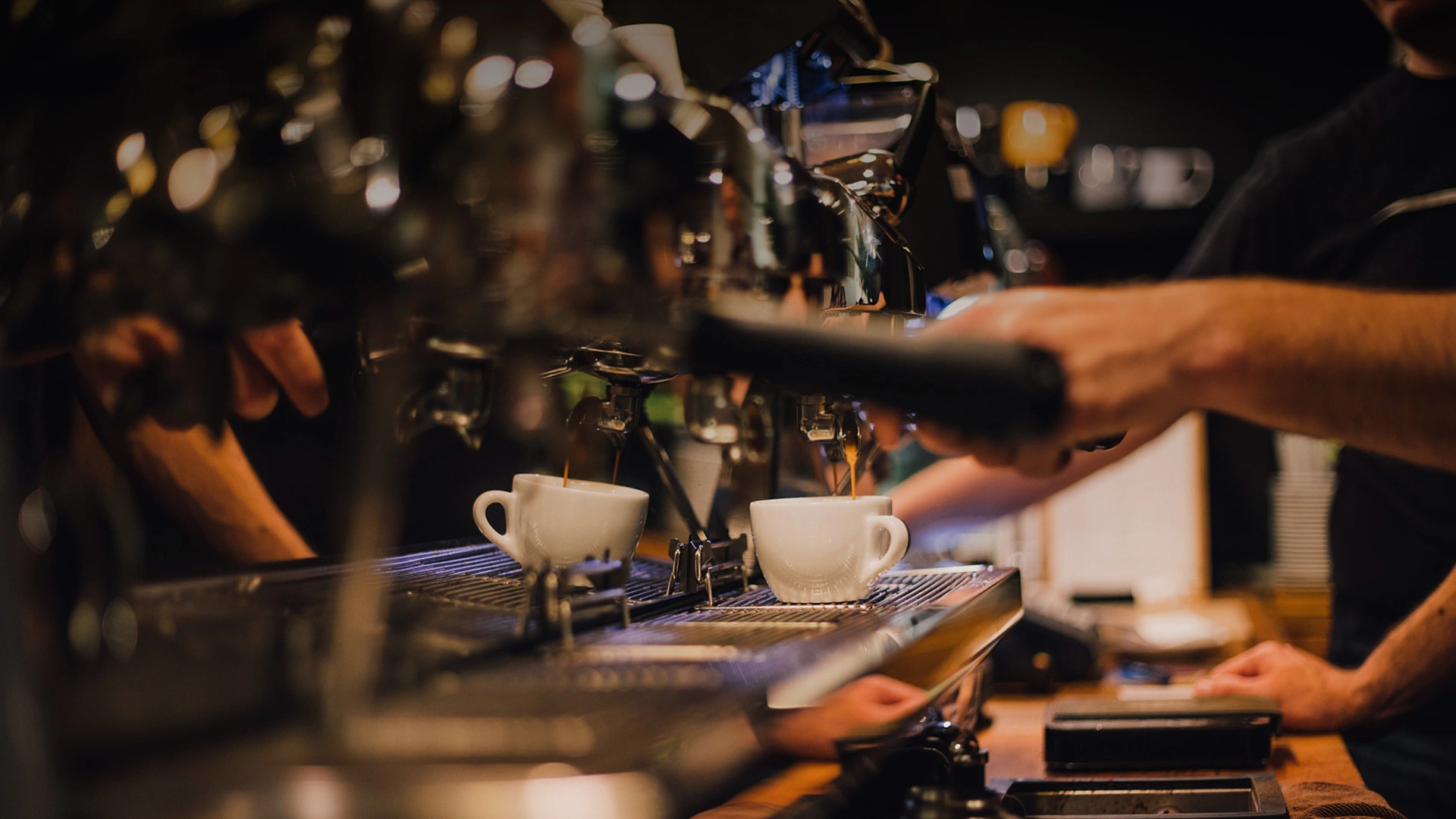
Hot water passes through the group head and into the coffee grounds held inside the portafilter basket. The brewed espresso then flows into the cup below.
The number of group heads affects how many portafilters can be used at the same time.
A single-group commercial espresso machine has one brewing group. A two-group commercial espresso machine has two separate brewing groups positioned next to each other.
Each group can normally hold either a single-spout or double-spout portafilter. This means one group may prepare one or two espresso shots during a brewing cycle, depending on the basket and portafilter being used.
The number of group heads is important, but it is not the only factor that determines output. Boiler capacity, heating performance, steam power, grinder speed, barista experience, and drink complexity all affect real-world service capacity.
What Is a Single-Group Commercial Espresso Machine?
A single-group commercial espresso machine has one group head and is generally designed for lower or moderate-volume professional use.
It is often selected by businesses that need commercial espresso capability but do not require two baristas to brew simultaneously.
Common applications include:
- Small cafés
- Restaurants
- Bakeries
- Bars
- Hotel lounges
- Office coffee areas
- Mobile coffee carts
- Food trucks
- Showrooms
- Small hospitality venues
Single-group machines are available in different configurations. Some are compact semi-professional models, while others are fully plumbed commercial machines with strong steam performance, volumetric controls, and larger boilers.
The term “single-group” therefore describes the number of brewing groups, not necessarily the overall quality or power of the machine.
What Is a Two-Group Commercial Espresso Machine?
A two-group commercial espresso machine has two group heads, allowing two portafilters to be used at the same time.
This configuration is common in busy cafés, restaurants, hotels, bakeries, and coffee-service businesses that need to prepare several drinks during peak periods.
A two-group machine can support a more efficient workflow because one barista may brew on both groups, or two baristas may operate the machine together.
It may also provide:
- More brewing flexibility
- Better peak-hour capacity
- Additional steam performance
- Larger boilers
- More working space across the front of the machine
- Greater redundancy during service
However, two-group machines are generally wider, heavier, and more demanding in terms of installation and utilities.
Single-Group vs Two-Group Commercial Espresso Machines at a Glance
| Comparison | Single-group machine | Two-group machine |
|---|---|---|
| Number of group heads | One | Two |
| Typical service level | Low to moderate volume | Moderate to high volume |
| Counter-space requirement | Smaller | Larger |
| Number of simultaneous operators | Usually one | One or two |
| Peak-hour flexibility | More limited | Greater |
| Initial investment | Usually lower | Usually higher |
| Power requirements | Often lower | Often higher |
| Boiler capacity | Commonly smaller | Commonly larger |
| Installation complexity | Often simpler | Usually more demanding |
| Best suited to | Small cafés, restaurants, carts, bars | Busy cafés, hotels, bakeries, restaurants |
1. Expected Daily Coffee Volume
Daily cup volume is one of the first factors buyers consider, but total daily volume does not tell the complete story.
A business may sell 100 coffee drinks throughout a long operating day without experiencing serious pressure on the machine. Another business may need to prepare 40 drinks within a short breakfast period.
The second business may require more brewing capacity even though its total daily sales are lower.
When a single-group machine may be sufficient
A single-group machine may be suitable when:
- Espresso orders are distributed throughout the day
- Coffee is a secondary part of the menu
- One employee operates the coffee station
- Most orders are simple espresso-based drinks
- Peak periods are manageable
- The business has limited counter space
- Customers do not order many drinks at the same time
Restaurants often fit this profile. They may serve coffee after meals, but demand is usually spread across different tables rather than concentrated into a café-style queue.
When a two-group machine may be better
A two-group machine may be the better option when:
- Several coffee orders arrive together
- Morning demand is especially strong
- Coffee is a major source of revenue
- Two employees may use the machine
- Customers expect fast service
- The menu includes many milk-based beverages
- The business expects future growth
The key question is not simply, “How many cups will we sell per day?” It is also, “How many drinks must we prepare during our busiest 15 to 30 minutes?”
2. Peak-Hour Workflow
Peak-hour performance is one of the biggest differences between a single-group and two-group commercial espresso machine.
With a single-group machine, the operator must complete brewing cycles through one group head. The barista can still prepare milk, organize cups, and take orders while espresso is extracting, but the brewing position remains limited to one group.
With a two-group machine, the operator can start another extraction while the first group is in use. This creates more flexibility when several drinks are waiting.
For example, one group can prepare a double espresso while the second group prepares shots for two milk-based drinks.
However, the extra group head only improves productivity when the rest of the workflow can keep up.
The business should also consider:
- Grinder speed
- Number of grinders
- Milk-steaming capacity
- Cup preparation
- Order organization
- Barista experience
- Counter layout
- Payment and service process
A two-group machine paired with a slow grinder and poorly designed workspace may still struggle during busy periods.
3. Number of Baristas
Staffing should influence the machine configuration.
One barista
A single barista can operate either a single-group or two-group machine.
A two-group machine gives one experienced barista more flexibility, but it does not automatically double output. The same person must still grind coffee, dose the portafilters, steam milk, assemble drinks, and clean the workspace.
For a low-volume business, a single-group machine may provide enough capacity without occupying unnecessary space.
For a busy coffee bar, one skilled barista may benefit from two groups because several extractions can be organized at the same time.
Two baristas
A two-group machine is generally more suitable when two baristas work together.
One barista may handle espresso preparation while the second manages milk and drink assembly. In another workflow, each barista may use one group.
A single-group machine can become a bottleneck when two employees need access to the brewing area simultaneously.
Before purchasing, consider whether the coffee station is designed for one person or a team.
4. Counter Space and Machine Size
Commercial espresso machines require more space than their external dimensions suggest.
Buyers should allow room for:
- Coffee grinders
- Tampers and tamping mats
- Knock boxes
- Milk jugs
- Cups and saucers
- Cleaning tools
- Water filtration
- Ingredient storage
- Staff movement
A single-group commercial espresso machine is usually narrower and may be easier to install in a restaurant, bakery, mobile cart, or compact bar.
A two-group machine requires a wider counter and more working space around it. It may also be deeper and heavier.
Measure the installation area carefully before ordering. Check the machine’s:
- Width
- Depth
- Height
- Net weight
- Required ventilation clearance
- Portafilter clearance
- Cup-warmer height
- Access for servicing
A machine that technically fits the counter may still be difficult to operate if there is not enough space for grinders, milk preparation, and cleaning.
5. Boiler Capacity and Heating Performance
The number of group heads should not be evaluated separately from the heating system.
Commercial espresso machines may use:
- Single-boiler systems
- Heat-exchanger systems
- Dual-boiler systems
- Multi-boiler systems
- Thermoblock-assisted systems
Boiler size and heating power affect temperature recovery, hot-water supply, and steam performance.
Two-group machines often have larger boilers because they are designed for heavier service. This can provide stronger steam performance and better recovery during continuous drink preparation.
However, specifications vary widely between models.
A high-quality single-group commercial machine may outperform a basic two-group model in certain working conditions. Buyers should therefore review the complete technical specification rather than judging the machine only by the number of groups.
Important questions include:
- What is the boiler capacity?
- Is the brewing temperature adjustable?
- How quickly does the machine recover?
- Can brewing and steaming happen simultaneously?
- How many steam wands are included?
- Is there a separate hot-water outlet?
- Is the machine designed for continuous commercial use?
6. Milk-Based Beverage Demand
Milk drinks can place more pressure on the machine than espresso alone.
Cappuccinos, lattes, flat whites, and other milk-based beverages require both espresso extraction and steam power.
A business serving mostly espresso and Americano may not need the same steam capacity as a café selling a large number of lattes.
Single-group machines and milk service
A commercial single-group machine can be suitable for milk beverages when demand is moderate and the steam system is powerful enough.
It may work well in:
- Restaurants
- Small bakeries
- Bars
- Boutique hotels
- Coffee carts
- Low-volume cafés
The operator should still confirm that the machine can brew and steam efficiently during repeated orders.
Two-group machines and milk service
A two-group machine is usually more appropriate when milk beverages make up a large part of the menu and several orders arrive together.
The larger heating system commonly found in two-group machines can support longer steaming periods and quicker service recovery.
Some models include two steam wands, allowing two baristas to texture milk at the same time.
7. Power, Water, and Drainage Requirements
Installation requirements can affect the final purchasing decision.
Electrical supply
Two-group machines generally require more electrical power than single-group machines. Depending on the model and destination market, the machine may need:
- A dedicated electrical circuit
- A higher amperage connection
- Single-phase or three-phase power
- A specific voltage
- Installation by a qualified electrician
Never assume that an existing wall socket is suitable.
Water connection
Many traditional commercial espresso machines use a direct water connection. A stable water supply allows continuous operation without manually refilling a tank.
Some compact single-group machines may include a removable water tank, making them suitable for mobile or temporary installations.
Drainage
Plumbed commercial machines may require a drainage connection for the drip tray.
Buyers should confirm the water inlet, drainage position, hose requirements, and installation distance before placing an order.
Water filtration
Water quality affects coffee flavor, heating performance, and machine lifespan.
A suitable filtration or treatment system can help reduce scale and protect internal components. The correct system depends on local water conditions.
Water treatment should be planned as part of the installation rather than treated as an optional accessory.
8. Initial Cost and Long-Term Value
A single-group commercial espresso machine generally has a lower purchase price than a comparable two-group model.
It may also reduce:
- Shipping cost
- Installation cost
- Energy consumption
- Counter-space requirements
- Maintenance complexity
For a business with moderate coffee demand, this can make a single-group machine the more economical choice.
A two-group machine usually requires a larger investment, but the additional capacity may be valuable when coffee sales are high or service speed directly affects revenue.
Buying a machine that is too small may lead to:
- Longer customer waiting times
- Staff frustration
- Inconsistent workflow
- Lost orders during peak periods
- Early replacement as the business grows
Buying a machine that is unnecessarily large may create:
- Higher upfront costs
- Greater power consumption
- Wasted counter space
- More complex installation
- Capacity that is rarely used
The best value comes from matching the equipment to the actual operating environment.
9. Cleaning and Maintenance
Both single-group and two-group commercial espresso machines require regular cleaning.
Typical daily tasks include:
- Flushing the group heads
- Cleaning portafilters and baskets
- Wiping and purging steam wands
- Emptying and cleaning the drip tray
- Backflushing when required
- Cleaning the machine exterior
- Cleaning the grinder area
A two-group machine has more brewing components to clean, but the general maintenance process is similar.
Businesses should establish a cleaning routine and assign responsibility to specific employees.
Preventive maintenance should also include inspection of:
- Group-head seals
- Shower screens
- Steam valves
- Water filtration
- Pumps
- Heating components
- Electrical connections
Before purchasing, ask the supplier about recommended service intervals, spare-parts availability, technical documentation, and warranty support.
Which Machine Is Better for a Small Café?
A single-group machine may be suitable for a small café when:
- The coffee menu is limited
- Order volume is moderate
- One barista works at a time
- Counter space is restricted
- Peak-hour demand is manageable
- The business is still testing the market
However, a small café may still need a two-group machine if most customers arrive within the same morning period.
Floor area alone should not determine machine size. A compact café with strong takeaway demand may require more brewing capacity than a large restaurant.
Which Machine Is Better for a Busy Coffee Shop?
A two-group commercial espresso machine is usually the safer choice for a busy coffee shop.
It provides more flexibility for:
- Consecutive espresso orders
- Multiple milk drinks
- Two-barista workflows
- Different coffee recipes
- Peak-hour service
- Business growth
The machine should still be paired with suitable grinders, adequate steam capacity, water treatment, and an efficient counter layout.
Which Machine Is Better for a Restaurant?
Many restaurants can operate effectively with a single-group commercial espresso machine.
Coffee is often ordered after meals rather than continuously throughout the day. A compact machine may provide sufficient capacity without occupying too much bar space.
A two-group machine may be better when:
- The restaurant has a strong breakfast service
- Coffee is an important part of the menu
- Several tables order coffee simultaneously
- The venue includes a separate café or bakery
- The restaurant serves a high number of milk drinks
- Events and group bookings create sudden demand
Which Machine Is Better for a Hotel?
Hotels should evaluate each service area separately.
A single-group machine may be suitable for:
- Small hotel bars
- Executive lounges
- Boutique properties
- Low-volume restaurants
- Meeting rooms with staffed beverage service
A two-group machine may be more suitable for:
- Breakfast restaurants
- Lobby cafés
- Banquet operations
- Large hospitality properties
- High-volume food-and-beverage areas
A hotel may use different machine configurations in different locations rather than selecting one model for the entire property.
Which Machine Is Better for a Bakery?
Bakeries often experience concentrated morning traffic.
A bakery with moderate coffee demand may use a single-group machine, especially when pastries and bread remain the main products.
A two-group machine may be preferable when takeaway coffee forms an important part of revenue or when customers regularly order several drinks together.
The bakery should consider queue length, morning service speed, employee training, and available counter space.
Which Machine Is Better for a Coffee Cart or Food Truck?
Mobile businesses normally have strict limits on space, weight, power, and water.
A compact single-group commercial espresso machine is often the practical choice.
Before purchasing, check:
- Available electrical power
- Water-tank capacity
- Wastewater storage
- Machine weight
- Counter dimensions
- Heat and ventilation
- Transportation stability
- Required daily output
A two-group machine may be possible in a larger mobile setup, but installation and utility requirements must be planned carefully.
Should You Consider a Three-Group Espresso Machine?
Three-group commercial espresso machines are designed for high-volume environments where several baristas need to work simultaneously.
They may be suitable for:
- Large specialty cafés
- High-traffic transport locations
- Event venues
- Busy hotel operations
- Large coffee chains
- Commercial training centers
However, most small and medium-sized businesses will choose between single-group and two-group machines.
A three-group machine requires more counter space, greater utility capacity, and a workflow capable of using the additional brewing position.
It should only be selected when the expected demand justifies the investment.
Questions to Ask Before Choosing a Group Configuration
Before ordering a commercial espresso machine, answer the following questions:
- How many coffee drinks will be sold each day?
- How many drinks must be prepared during the busiest period?
- How many employees will operate the machine?
- What percentage of orders will be milk-based?
- Is coffee the main product or a secondary menu item?
- How much counter space is available?
- Is a direct water connection available?
- Is drainage available?
- What voltage and electrical capacity are available?
- How much steam power is required?
- Will the business expand its coffee menu?
- Is the machine intended for one location or multiple projects?
- Are local product certifications required?
- Are spare parts and technical support available?
- What is the complete installation budget?
These questions will help the supplier recommend an appropriate machine instead of simply recommending the largest model.
Single-Group vs Two-Group Commercial Espresso Machine: Final Decision
Choose a single-group commercial espresso machine when your priorities are:
- Compact installation
- Moderate coffee volume
- One-person operation
- Lower initial investment
- Simpler utility requirements
- Mobile or space-limited use
- Coffee as a secondary menu item
Choose a two-group commercial espresso machine when your priorities are:
- Faster peak-hour service
- Greater brewing flexibility
- Two-barista operation
- Higher coffee volume
- Strong milk-drink demand
- Business growth
- Coffee as a major revenue category
The correct decision should be based on peak-hour demand, not only average daily sales.
A properly selected single-group machine can be more useful than an oversized two-group machine. At the same time, a growing café should avoid choosing a machine that becomes a bottleneck soon after opening.
Find the Right Commercial Espresso Machine with Carefor Cafe
Carefor Cafe supplies commercial coffee equipment for cafés, restaurants, hotels, bakeries, offices, distributors, and hospitality projects.
Our product range includes semi-professional and professional espresso machines, coffee grinders, drip coffee makers, coffee brewers, coffee urns, and hot water dispensers.
We can support commercial buyers with:
- Product selection
- Technical specifications
- Single-group and multi-group options
- Voltage and plug requirements
- Wholesale purchasing
- OEM and ODM projects
- Customized branding and packaging
- Certification information
- Spare-parts planning
- Export and shipping support
Contact Carefor Cafe with your expected daily volume, peak-hour demand, menu, counter dimensions, and installation conditions. Our team will help you compare suitable commercial espresso machine options for your market or project.