

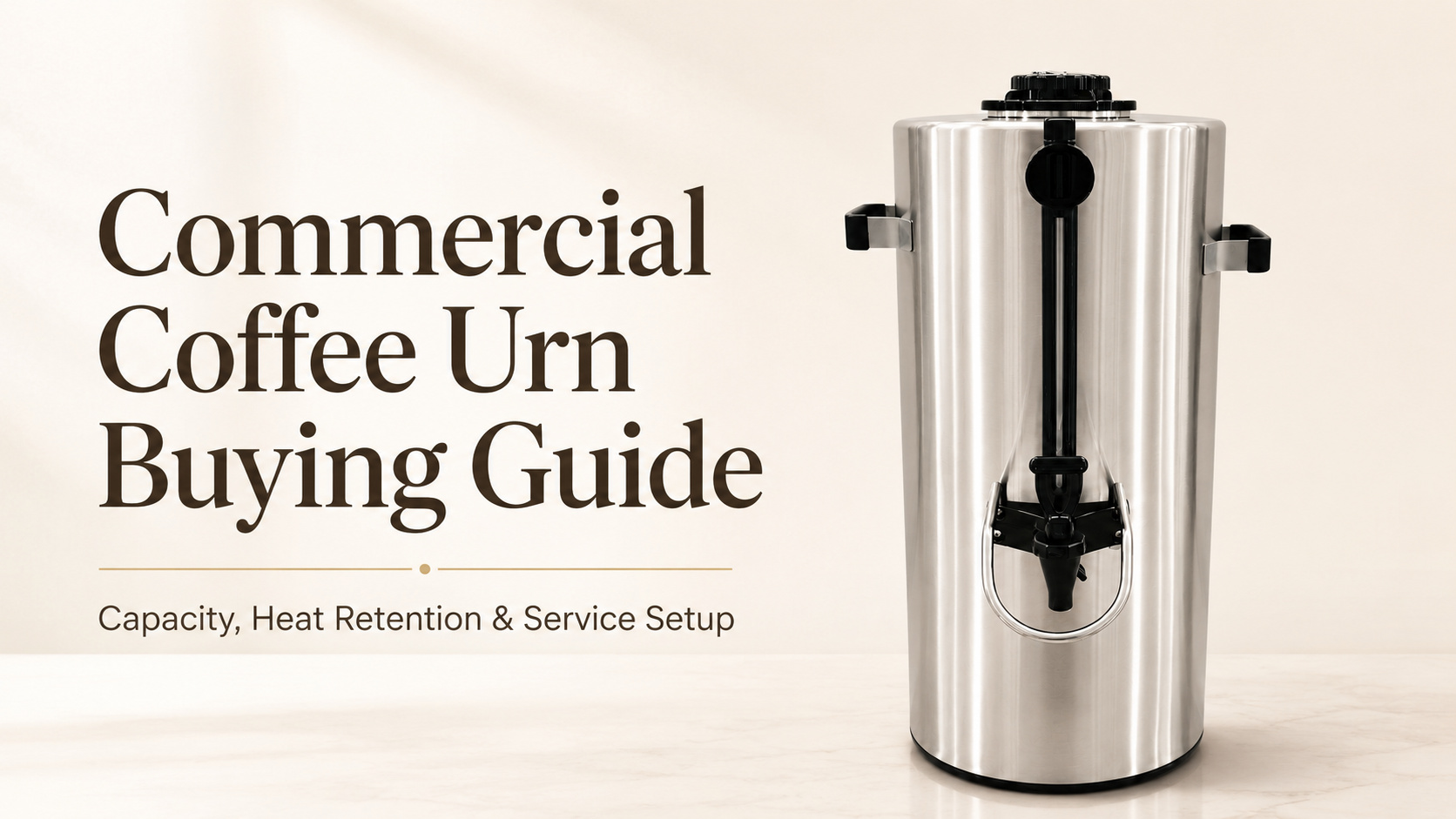
Commercial Coffee Urn Buying Guide: Capacity, Heat Retention, and Service Setup
A reliable coffee service does not always require a complicated brewing system. In hotels, meeting rooms, offices, catering operations, and self-service breakfast areas, businesses often need a simple way to hold prepared coffee and serve it efficiently over an extended period.
A commercial coffee urn provides a practical solution for large-volume coffee service. It allows staff to prepare coffee in advance, transfer it into the urn, and serve multiple guests without repeatedly brewing individual batches.
However, not every coffee urn is suitable for commercial use. Capacity, heat retention, construction, serving design, cleaning, and transport all affect how well the equipment performs during daily operation.
This guide explains the main factors to consider when choosing a commercial coffee urn.
What Is a Commercial Coffee Urn?
A commercial coffee urn is a large-capacity container designed to hold and serve prepared coffee.
It is important to distinguish a coffee urn from a commercial drip coffee brewer. A drip brewer prepares coffee by passing hot water through ground coffee. A coffee urn is mainly used to store, retain the temperature of, and serve coffee that has already been prepared.
This makes coffee urns suitable for locations where coffee must remain available for groups of customers during breakfast service, meetings, events, or self-service periods.
Depending on the model, a coffee urn may include:
- A stainless steel body
- Thermal insulation
- A large-capacity inner container
- A serving spigot
- Side carrying handles
- A secure lid
- A visible liquid-level indicator
- A protective base
The right design helps staff serve coffee quickly while keeping the service area organized.
Who Uses Commercial Coffee Urns?
Commercial coffee urns can be used in many hospitality and food-service environments.
Hotels
Hotels can place coffee urns in breakfast areas, meeting rooms, lounges, or conference spaces. Guests can serve themselves, reducing the need for staff to prepare each cup individually.
Catering companies
Catering teams often need to prepare drinks in one location and transport them to another. A coffee urn with strong handles, a secure lid, and good heat retention is easier to move between kitchens, banquet halls, and event venues.
Cafés and bakeries
A café may use a coffee urn for batch-prepared coffee during busy periods, group orders, events, or external catering service.
Offices
Large offices can use coffee urns in meeting rooms, staff kitchens, training rooms, and corporate events. One large container can serve many employees without requiring constant preparation.
Conference and event venues
Coffee urns are useful for seminars, exhibitions, weddings, conferences, and other situations where many guests need access to coffee within a limited period.
1. Choose the Right Capacity
Capacity is one of the first factors to consider.
A coffee urn that is too small may require frequent refilling. A unit that is unnecessarily large may take up too much counter space and may not match the actual number of guests.
Before choosing a size, consider:
- The expected number of guests
- The average cup size
- How long the service period will last
- Whether refilling is practical
- Whether coffee will be served at one station or several stations
- How much counter or buffet space is available
A large-capacity model, such as a 3-gallon commercial coffee urn, may be suitable for hotel breakfasts, catering events, office functions, and conference service.
For larger events, several medium-sized urns may sometimes be more practical than one very large unit. Multiple urns allow operators to create separate service points and reduce queues.
2. Evaluate Heat-Retention Performance
Coffee should remain at an appropriate serving temperature without being exposed to unnecessary reheating.
Good thermal insulation helps reduce temperature loss during service. This is especially important when the urn is used away from a kitchen or power source.
When comparing models, check:
- The insulation structure
- The thickness and construction of the body
- The lid design
- How securely the lid closes
- How long the urn is expected to hold temperature
- Whether the outer surface remains manageable during use
A well-insulated coffee urn can support hotel buffets, meetings, and catering operations where prepared coffee must remain available for an extended service period.
Heat retention can also support a more consistent guest experience. Customers arriving later in the service period should receive coffee that is reasonably close in temperature to coffee served at the beginning.
3. Look for Commercial-Grade Stainless Steel Construction
Stainless steel is commonly selected for commercial coffee-service equipment because it offers a professional appearance and is suitable for repeated use.
When evaluating construction, examine:
- The quality of the inner container
- The strength of the outer body
- The connection between handles and the main body
- The base and bottom protection
- The finish around the lid and spigot
- The quality of welded or joined areas
A strong body is particularly important for catering companies and mobile service operations. Equipment that is frequently lifted, transported, cleaned, and stored must be able to withstand regular handling.
The exterior finish also affects presentation. A clean stainless steel coffee urn fits naturally into hotel buffets, restaurant counters, office kitchens, and event-service areas.
4. Check the Serving Spigot
The serving spigot is one of the most frequently used parts of a coffee urn.
It should allow guests or staff to pour coffee smoothly without excessive dripping, splashing, or complicated operation.
Consider the following points:
- Is the lever easy to operate?
- Can it be used with one hand?
- Is there enough space below the spigot for common cup sizes?
- Does the liquid flow smoothly?
- Can the spigot be removed or accessed for cleaning?
- Does the design help reduce accidental opening during transport?
For self-service areas, operation should be immediately understandable. Guests should not require instructions simply to pour a cup of coffee.
The spigot should also feel secure. Loose or weak components can create leaks and increase maintenance requirements.
5. Consider the Liquid-Level Indicator
A visible level indicator allows staff to see approximately how much coffee remains without opening the lid.
This is particularly useful during busy service periods. Staff can check the level from a distance and prepare a refill before the urn becomes empty.
A practical liquid-level system should be:
- Easy to read
- Positioned clearly on the front
- Protected from accidental damage
- Easy to clean
- Properly connected to the main container
For hotel buffets and meetings, this feature can reduce unnecessary lid opening and improve service planning.
6. Examine the Lid Design
The lid affects temperature retention, transport safety, and cleaning.
A suitable commercial lid should:
- Fit securely
- Be easy for staff to remove
- Help limit heat loss
- Remain stable during normal operation
- Include a practical handle or knob
- Be easy to clean around the edges
For catering and mobile service, lid security becomes even more important. The urn should always be transported carefully and preferably when empty, but a stable lid still helps protect the interior from dust and contamination during setup.
7. Check the Side Handles
Side handles make the urn easier to lift, position, and remove from a service counter.
The handles should be securely attached and comfortable to grip. Their position should allow staff to carry the urn without placing their hands too close to the spigot or lid.
Important details include:
- Handle strength
- Grip comfort
- Heat-resistant contact areas
- Adequate space for the hands
- Stable attachment to the body
Before moving a filled urn, operators should always consider the total weight and follow appropriate handling procedures.
8. Consider Cleaning and Daily Maintenance
Coffee oils and residue can affect cleanliness, appearance, and flavor if the urn is not cleaned properly.
Choose a model with an interior that is easy to access. Staff should be able to reach the main container, lid, level indicator, and serving components.
A daily cleaning routine may include:
- Emptying any remaining coffee.
- Rinsing the inner container.
- Cleaning the interior with an appropriate food-service cleaning method.
- Flushing and cleaning the spigot.
- Cleaning the lid and level indicator.
- Wiping the exterior.
- Allowing all components to dry before storage.
Avoid abrasive materials that could damage the stainless steel finish. The specific cleaning method should always follow the product instructions.
Easy cleaning is especially valuable in hotels and catering businesses, where equipment may need to be prepared again quickly for the next service period.
9. Plan the Service Area
The coffee urn should be positioned where guests can use it comfortably without creating congestion.
A suitable setup may include:
- Cups placed close to the urn
- Sufficient space below the spigot
- Napkins and stirrers nearby
- Milk, cream, sugar, and sweeteners positioned separately
- A drip tray or easily cleaned surface
- Clear identification of the beverage
- Enough space for guests to move through the service area
For busy breakfast service, consider using separate stations for coffee, tea, and hot water. This helps reduce queues and prevents guests from gathering around one piece of equipment.
10. Coffee Urn vs. Commercial Coffee Brewer
A coffee urn and a commercial coffee brewer perform different functions.
Choose a commercial coffee brewer when:
- Coffee needs to be brewed on site
- Fresh batches are produced throughout the day
- The business requires a complete brewing system
- Brewing speed and batch consistency are priorities
Choose a coffee urn when:
- Coffee is prepared separately
- The main requirement is holding and serving
- The equipment must be simple to operate
- The unit may need to be moved between service areas
- A self-service setup is required
Many businesses use both. A commercial brewer prepares the coffee, while one or more coffee urns support serving in different areas.
For example, a hotel kitchen may prepare coffee centrally and transfer it into urns located in the breakfast room, conference area, and event space.
Commercial Coffee Urn Buying Checklist
Before making a purchasing decision, confirm the following:
- Does the capacity match the expected number of guests?
- Is the unit designed for commercial use?
- Does it provide suitable heat retention?
- Is the body made from durable stainless steel?
- Is the spigot easy to operate and clean?
- Can staff check the remaining coffee level?
- Are the handles securely attached?
- Does the lid fit properly?
- Is the interior easy to access?
- Will the urn fit the available counter space?
- Can the supplier support wholesale or customized orders?
- Are packaging, spare parts, and after-sales support available?
Frequently Asked Questions
Does a commercial coffee urn brew coffee?
Not always. Many coffee urns are designed primarily to hold and serve prepared coffee. A commercial drip coffee brewer is used when coffee must be brewed directly by the equipment.
What capacity should a hotel choose?
The correct capacity depends on the number of guests, cup size, length of service, and refill schedule. Hotels with several service areas may benefit from using multiple urns rather than relying on a single unit.
Is stainless steel suitable for a commercial coffee urn?
Stainless steel provides a professional appearance and is suitable for repeated commercial handling when the urn is properly used and maintained.
Can a coffee urn be used for catering?
Yes. A coffee urn can be useful for catering when it has reliable heat retention, secure handles, a practical lid, and a serving system suitable for events.
How often should a coffee urn be cleaned?
The urn should be cleaned after each service period. The spigot and liquid-level components also require regular attention because coffee residue may build up inside them.
Can one urn be used for both coffee and tea?
That depends on the product design and operating instructions. From a flavor-control perspective, many operators prefer to dedicate separate equipment to coffee and tea.
Conclusion
The best commercial coffee urn is not simply the largest model available. It should match the number of guests, service duration, available space, cleaning routine, and operating environment.
Capacity, heat retention, stainless steel construction, an easy-to-use spigot, strong handles, and straightforward cleaning all contribute to reliable commercial coffee service.
For hotels, offices, catering companies, cafés, and event operators, a well-selected coffee urn can simplify beverage service and help staff serve large groups more efficiently.
Careforcafe supplies commercial beverage and coffee-service equipment for hospitality and food-service businesses. Contact our team for product information, wholesale pricing, and OEM/ODM cooperation.