
7 Questions to Ask a Commercial Coffee Brewer Supplier Before You Buy
Comparing commercial coffee brewers is not only about price, appearance or a specification sheet. A machine that works well in a small office may not suit a hotel breakfast service, catering operation or busy café. Before selecting a supplier, buyers should first confirm how the equipment will be used, what the busiest service period looks like and what support will be available after delivery.
These seven questions will help distributors, project buyers and hospitality operators compare commercial coffee brewer suppliers more effectively.
1. What is the actual application?
Start with the location and service model. Is the brewer intended for a hotel breakfast buffet, office pantry, restaurant, café, convenience store, catering setup or equipment distribution programme? Each application may require a different brewing capacity, serving method and installation arrangement.
A good supplier should ask about the business situation before recommending a model. If every buyer receives the same recommendation, the supplier may be focusing on the product rather than the application.
2. What happens during the busiest 30 minutes?
Average daily consumption does not show whether a brewer can handle peak demand. A hotel may serve most of its coffee within a short breakfast window, while an office may experience demand at the beginning of the workday and after lunch.
Tell the supplier approximately how many cups are required during the busiest 30 minutes, how often staff can start a new brew cycle and whether customers serve themselves. This information helps determine the appropriate batch size, number of brewing stations and holding arrangement.
3. Which water-filling and installation conditions are available?
Commercial drip coffee machines may use manual water filling, a direct water connection or a configuration that supports both. The right option depends on the site.
- Is a fixed water line available?
- Is there enough counter space around the brewer?
- What local voltage and plug type are required?
- Does the water quality require filtration or treatment?
These details should be confirmed before production. Do not assume that a machine can use a particular water connection, voltage or installation method unless the supplier has verified it for the selected model.
4. How will the coffee be brewed, held and served?
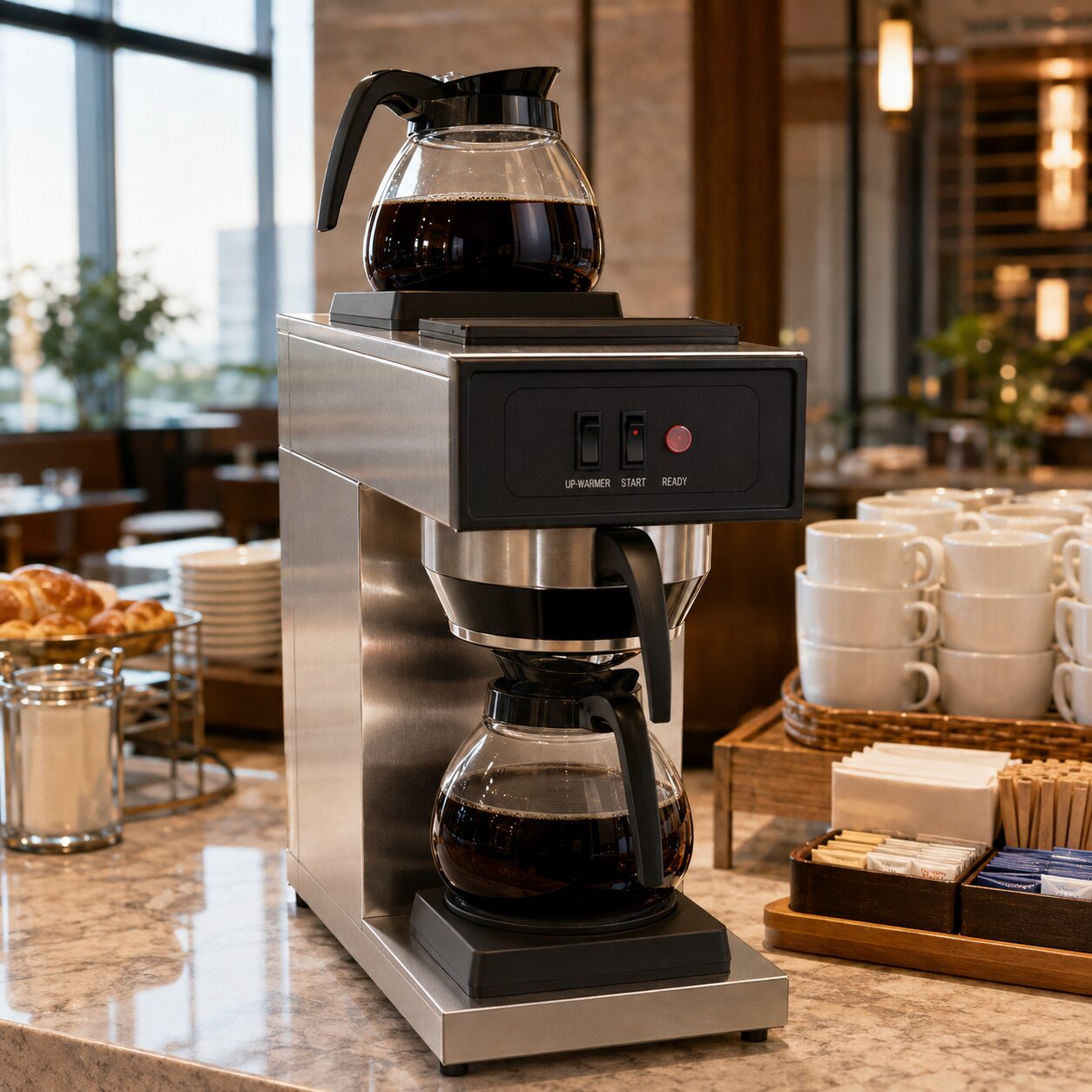
The serving method affects the complete equipment setup. Some operations use glass decanters on warming plates, while others prefer thermal servers or airpots. Buyers should discuss expected holding time, refill frequency and whether more than one batch needs to be available at the same time.
This conversation helps prevent two common problems: choosing insufficient capacity for peak periods or selecting more stations than the operation can use efficiently.
5. What cleaning and routine maintenance are required?
Ask the supplier to explain the daily cleaning steps, recommended descaling routine and access to parts that may require regular inspection or replacement. The answer should be practical enough for the staff who will actually operate the brewer.
For distributors and project buyers, also confirm whether operating instructions, maintenance guidance and spare-parts information can be supplied for the destination market.
6. What factory testing is completed before shipment?
Testing should match the equipment and the confirmed order requirements. Ask which electrical, heating, water-flow, brewing and leakage checks are performed, and whether records, photos or videos can be provided when required.
Certification, performance figures and test results should only be used in marketing materials after they have been confirmed for the exact model and order. Avoid relying on general factory statements that do not identify what was tested.
7. What support is available after the order?
After-sales support is especially important for overseas distributors and OEM/ODM buyers. Discuss the process for technical questions, spare parts, manuals, packaging, labels and order-specific configurations before placing the order.
It is also useful to confirm who will handle communication during sampling, production and shipment. Clear responsibilities reduce delays and make future orders easier to manage.
A simple supplier-comparison checklist
| Area to confirm | Information to prepare |
|---|---|
| Application | Hotel, office, café, restaurant, catering or distribution |
| Peak demand | Estimated cups during the busiest 30 minutes |
| Installation | Water connection, voltage, plug and counter space |
| Serving method | Glass decanter, thermal server or airpot |
| Maintenance | Cleaning, descaling, manuals and spare parts |
| Testing | Confirmed factory checks and available records |
| Support | Technical contact, OEM/ODM details and order communication |
Choose the supplier after defining the application
A commercial coffee brewer should be selected around real service conditions, not only catalogue specifications. When buyers provide the application, peak demand, installation conditions and local electrical requirements, suppliers can make more relevant recommendations and reduce avoidable changes later.
CareforCafe is a commercial beverage equipment solution provider supporting distributors and project buyers with commercial drip coffee machines, commercial filter coffee machines and related beverage equipment. To discuss an OEM/ODM project, send us your application, expected peak demand, installation conditions and destination market.
Contact CareforCafe or explore more practical buying guidance in our Coffee Academy.